
Three different drinks share this name, and only one of them contains coconut water. Coconut water is the liquid from a young green coconut, at about 19 kcal and 250 mg potassium per 100 ml. Sparkling coconut water is that liquid carbonated. Coconut-flavoured sparkling water is carbonated water with flavouring — 0 mg potassium.
The three products, side by side
| Coconut water | Sparkling coconut water | Coconut-flavoured sparkling water | |
|---|---|---|---|
| Contains coconut water | Yes, 100% | Yes | Usually none |
| Carbonated | No | Yes | Yes |
| Energy per 100 ml | ~19 kcal | ~15–19 kcal | 0–2 kcal |
| Potassium | ~250 mg | Present, diluted | None |
| Natural sugars | ~2.6 g | Lower, diluted | None |
| First ingredient | Coconut water | Coconut water | Carbonated water |
How to tell them apart in two seconds: read the first ingredient. If it says carbonated water and coconut appears only under “natural flavouring”, there is no coconut water in the can — and no potassium either.

What sparkling coconut water actually is
Coconut water carbonated with CO₂, usually at a lower carbonation level than a soft drink so the bubbles do not overwhelm a delicate flavour. It keeps the electrolyte profile of still coconut water while reading as a soft drink occasion rather than a health drink one.
Two technical points shape the category:
- Carbonation slightly lowers pH. Dissolved CO₂ forms carbonic acid. For a near-neutral product like coconut water that is marginally helpful for stability, though thermal processing still does the real work.
- Carbonation changes flavour perception. CO₂ sharpens and shortens the finish, which is why a sparkling version can carry less sugar than a still one and still taste balanced.
What coconut-flavoured sparkling water is
Carbonated water with coconut flavouring, generally zero calorie and zero sugar. It is a legitimate product and a reasonable replacement for a soft drink, but it is not a source of anything. The flavouring is present at a level measured in parts per million.
This matters because the two categories are marketed with overlapping imagery, and shoppers reasonably assume a tropical can contains tropical fruit. Often it does not.
What these drinks will not do
- “Coconut-flavoured sparkling water hydrates with electrolytes.” Flavoured sparkling water contains no meaningful electrolytes unless they have been added and declared. Plain water hydrates equally well.
- “Natural flavouring provides antioxidants and anti-inflammatory benefits.” At flavouring levels there is no nutritional contribution. “Natural” describes the origin of the compound, not a health effect.
- “It causes weight loss.” Replacing a sugary soft drink with a zero-calorie one reduces calorie intake. The drink itself does nothing further.
- “Sparkling water damages teeth like soda.” Plain sparkling water is mildly acidic from carbonic acid but far less erosive than sugary or citric-acid soft drinks. Sugar content is the bigger factor.
- “Coconut is a nut, so it is unsafe with nut allergies.” Coconut is botanically a drupe. US FDA labelling classes it as a tree nut, but most people with tree nut allergy tolerate it. Check with a clinician rather than relying on the label category.
How to read the label
- Check the first ingredient. Coconut water or carbonated water — this single line separates the categories.
- Look for a coconut water percentage. Products that contain it usually declare it; products that do not, stay vague.
- Check potassium on the nutrition panel. A meaningful figure means real coconut water. Zero means flavouring.
- Check for added sugar. Some sparkling coconut drinks add sugar on top of the natural content.
- Distinguish “coconut water” from “coconut milk”. Milk is pressed from the flesh and is far higher in fat.
How to use it
- Chilled and neat. Serve cold — carbonation and coconut aroma both fade as it warms.
- With lime and mint. Acidity lifts the coconut note, which is subtle on its own.
- As a mixer. Works with white rum or gin, and as a non-alcoholic base with pineapple or passion fruit juice.
- Topped over fruit juice. Lengthens a strong tropical juice without adding sugar.
It does not work in baking or in blended smoothies — the carbonation is lost in both, so you are paying for bubbles you then destroy.
Frequently asked questions
What is the difference between coconut water and coconut sparkling water?
Coconut water is the still liquid from inside a young green coconut, carrying around 250 mg of potassium per 100 ml. Sparkling coconut water is the same liquid carbonated. Coconut-flavoured sparkling water is a third product — carbonated water with flavouring and no coconut water — and contains no potassium.
Does coconut sparkling water have electrolytes?
If it is made from real coconut water, yes, though diluted relative to the still version. If it is coconut-flavoured sparkling water, no. Check the potassium figure on the nutrition panel — it is the quickest way to tell.
Is sparkling coconut water bad for your teeth?
Carbonation makes any sparkling drink mildly acidic, but plain sparkling water is far less erosive than sugary or citric-acid soft drinks. Added sugar and citric acid matter more than the bubbles.
Can I make coconut sparkling water at home?
Yes. Carbonate plain water and add chilled coconut water to taste, roughly one part coconut water to two parts sparkling. Do not carbonate coconut water directly in a home carbonator — its sugars foam heavily and are difficult to clean out.
Is coconut sparkling water suitable for a low-sugar diet?
Sparkling coconut water carries the natural sugars of coconut water, diluted — lower than fruit juice but not zero. Coconut-flavoured sparkling water is generally sugar-free. Check for added sugar in either case.
Which flavours pair well with coconut?
Pineapple, mango, lime and passion fruit are the reliable pairings. Coconut is a soft, low-acid flavour, so it needs either acidity or a sharper fruit to give it definition.
Sparkling coconut products from ACM Beverage
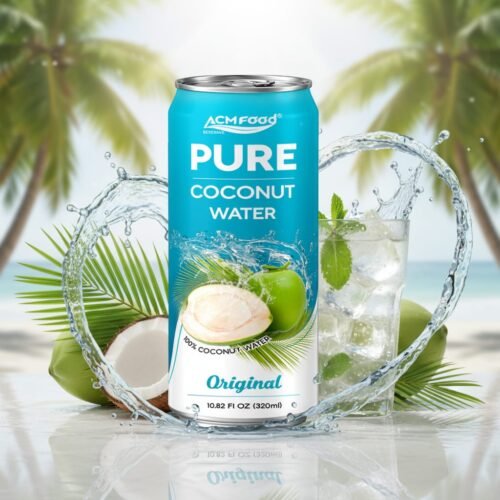
ACM Beverage manufactures sparkling coconut water and coconut-flavoured sparkling drinks in Vietnam under OEM and private label terms, in facilities certified to ISO 22000, FSSC 22000 and HACCP, exporting to more than 40 countries. Carbonation level is the key specification in this category — too much and it masks the coconut, too little and it reads flat.
See the sparkling drink range (73 SKUs), including the 320 ml sparkling coconut original, or the still coconut water range (96 SKUs). For market context see the rise of sparkling coconut water, or contact our export team.