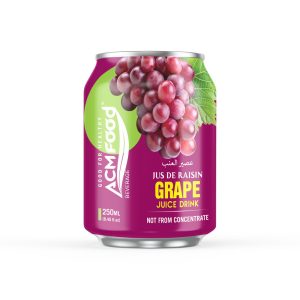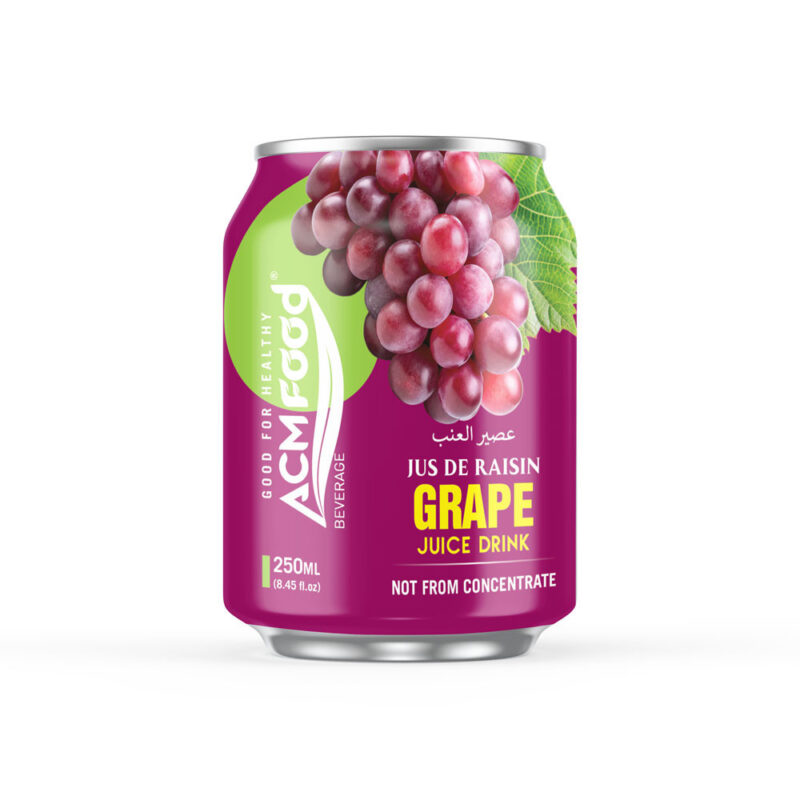











Almost every canned grape drink on the international market is rebuilt from concentrate long after the harvest ends, and buyers notice: reconstituted grape tends to taste flat and sugary, losing the slightly tannic finish that signals real fruit. A not-from-concentrate pressing keeps that finish, and that is the gap this product is built to fill.
Deep Grape Colour That Survives the Journey
The juice is pressed and filled without an evaporation step, so the aroma normally lost in concentrating remains in the can. No sugar is added and no colouring is used – the pigment of the fruit supplies the colour on its own. That matters practically as well as commercially, because grape pigments fade faster than almost any other under UV exposure, and aluminium blocks light completely. Across a 24-month ambient shelf life the drink holds both its colour and its flavour, with no cold chain required at any stage.
The 250ml Short Can in Convenience Retail
The short can is the format impulse channels prefer. It fits standard cooler shelving, prices comfortably as a single serve, ships at a fraction of the weight of glass and resists breakage on long ocean routes – damage claims on aluminium consignments run well below those on glass. For private label programmes the entire can surface is printable, which lets a distributor build an owned brand rather than resell someone else’s.
Supply Framework
Output reaches 20,000 cartons per day from a 500-carton minimum, so trial shipments and established programmes run on the same line without changing supplier. The facility is certified to FSSC 22000, HACCP and ISO 22000. Lead time is 15 to 30 days ex Ho Chi Minh City Port on T/T terms. Buyers assembling a wider portfolio can review the full fresh fruit juice range.