
Beverage MOQ is the minimum order quantity a supplier will accept for a private label or custom product. It is rarely a single number set by policy. It is the largest of several separate minimums that apply at the same time, and each one is set by a different supplier in the chain.
That distinction is what makes the question answerable. Once you know which of those minimums is the binding one for your product, you know which lever actually reduces the quantity, and which changes would make no difference at all.
Why is there a minimum order quantity at all?
Because several parts of making a drink cannot be bought or run in small amounts economically. Liquid is produced in batches sized to the equipment, printed packaging is manufactured to order in its own economic quantities, and a production run requires the line to be cleaned, set up and changed over regardless of how many units follow.
The result is that cost per unit falls sharply with volume at the low end and then flattens. A minimum quantity is the point at which the fixed elements are spread thinly enough for the product to be commercially sensible for both sides.
The five minimums that combine into one number
A quoted MOQ is usually the highest of the following. They are independent of each other, which is why changing one does not always move the answer.
| Component | What sets the minimum | How much it usually binds |
|---|---|---|
| Liquid batch | The size of the mixing and processing equipment | Often not the binding constraint |
| Cans or bottles | The container supplier’s own production run | Significant, especially for less common formats |
| Printed labels or sleeves | Print run economics, plates and setup | Very often the binding constraint |
| Closures and secondary packaging | Supplier order quantities for caps and cartons | Usually modest but occasionally decisive |
| Line changeover | Cleaning, setup and lost time between products | Raises the sensible minimum rather than a hard floor |
The pattern most brands do not expect is that the liquid is rarely the problem. It is the printed component, made to order and priced around a print run, that most often decides how small a first order can be.
What raises the minimum
Certain product decisions push the number up, and they are worth knowing before a concept is fixed rather than after.
- An unusual pack format. Common formats are produced continuously; a less common size or shape may be made in scheduled campaigns, which raises the quantity that can be bought at once.
- Full-body decoration. A sleeve or a printed can carries its own setup and run economics, generally above those of a simple applied label.
- Carbonation. A carbonated product adds process steps and equipment time, which affects changeover and therefore the sensible run size. Products such as lime sparkling juice sit in this group.
- Inclusions and particulates. Drinks containing pieces, such as guava juice with nata de coco, require specific dosing and filling handling that make very small runs impractical.
- A bespoke formulation. A recipe made only for one brand cannot be shared across other orders, so the whole batch belongs to that brand.
- Multiple variants. Each flavour is effectively its own product with its own printed components, so a range of four is not one order of a given size but four smaller ones.
What lowers it
The reductions available are the mirror image of the list above, and the effective ones attack whichever component is actually binding.
Choosing a widely produced format is usually the single largest reduction, because it removes the container supplier’s campaign schedule from the equation. Using an existing formula rather than a bespoke one means the liquid is not exclusive to a single order. Simplifying decoration, or accepting an applied label instead of a full sleeve for a first run, lowers the printed component minimum, which is frequently the one that matters. Reducing the number of launch variants concentrates the same total volume into fewer products, each of which then clears its own minimum more easily.
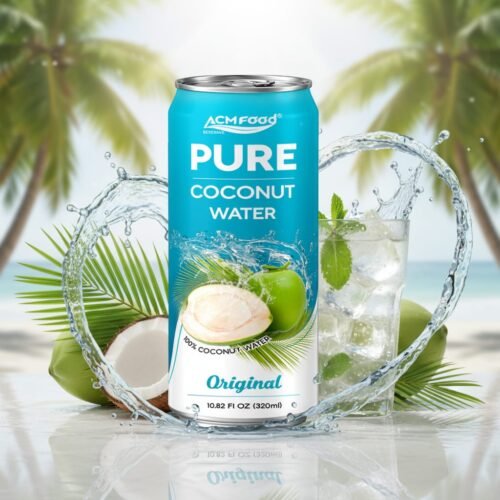
A single-ingredient product also tends to be simpler to run than a complex blend, which is part of why categories such as pure coconut water OEM supply are often accessible at smaller volumes than heavily formulated drinks.

MOQ for private label compared with custom development
The two routes behave differently. A private label order uses a formula that already exists, so the liquid minimum can sometimes be met within a shared production run, and the brand-specific element is the printed packaging. That usually makes the printed component the only real constraint.
A custom developed product is different in kind. The formulation belongs to that order alone, so the batch cannot be shared, and the minimum reflects the liquid as well as the packaging. Development cost is also spread across the first order, which raises the volume at which the project makes commercial sense even where a smaller run is technically possible.
This is why the same supplier can give two different answers to what appears to be the same question. The honest answer depends on which route is being priced.
How to ask the question so you get a useful answer
A request for a general minimum usually produces a general answer. A request that specifies the product produces a number that can be acted on.
- Name the format and size. A 250 ml slim can and a 500 ml PET bottle do not share a minimum.
- State whether the formula is existing or custom. This changes which components are exclusive to your order.
- Say how many variants. The total across a range is not the same question as the minimum per variant.
- Describe the decoration. Applied label, printed can or full sleeve carry different print minimums.
- Give the target market. Label language and mandatory content can make artwork market-specific, which splits a print run.
With those five, a supplier can identify the binding component and say what would move it, which is considerably more useful than a single figure quoted without context.
Why two suppliers quote different minimums
Comparing quoted minimums between suppliers is less straightforward than it looks, because the number depends on the equipment and the supply relationships behind it rather than on willingness alone.
Equipment scale is the first reason. A plant built around large batches has a higher natural floor than one running smaller vessels, and neither is better in general; they simply suit different order sizes. Packaging relationships are the second. A producer who buys a particular container in continuous volume can allocate part of that supply to a smaller order, while one who would have to place a fresh order cannot. Product mix is the third: a supplier already running a similar product can sometimes schedule a short run alongside it, which is not an option where nothing comparable is on the line.
The practical consequence is that a low quoted minimum is not automatically the better offer. It is worth checking what unit cost accompanies it, and whether the figure covers the printed packaging or assumes the buyer will meet that separately. A minimum that excludes a component you still have to buy at its own quantity is not the number it appears to be.
The cost question behind the quantity question
Brands usually ask about MOQ when the real concern is cash and risk. Seen that way, the minimum quantity is one variable among several, and it is not always the one worth optimising.
A smaller first run reduces the money committed but raises the unit cost, which can make the launch price uncompetitive. A larger run improves unit economics but ties up cash in inventory that has not yet proven it will sell. Between those, the deciding factor is usually shelf life: a product with a long durability date tolerates a larger first run because unsold stock retains value, while a shorter life makes overbuying expensive.
The practical approach is to work backwards from what can realistically be sold within a reasonable part of the product’s life, then check whether that quantity clears the binding minimum. If it does not, the question becomes which product decision to change rather than how to negotiate the number down.
What to confirm before ordering
Beyond the quantity itself, three details determine what the minimum actually means in practice. The first is whether the figure is per variant or across the order, since a range changes the arithmetic entirely. The second is whether packaging is included in the quoted quantity or ordered separately, because printed components sometimes have to be bought in their own quantities regardless of how much liquid is filled. The third is what happens to surplus printed material, as unused labels or sleeves from an over-ordered print run may be held for a repeat order or may not.
Frequently asked questions
Is MOQ negotiable?
Parts of it are and parts are not. Where the constraint is a supplier’s print run or container campaign, the quantity is set outside the beverage producer and there is limited room to move it. Where the constraint is scheduling or changeover, there is often more flexibility, particularly if timing is not urgent.
Does a trial order get a lower minimum?
Sometimes, depending on which component binds. A trial is easiest when an existing formula is used and the decoration can be simplified, because both of those attack the usual constraints. It typically carries a different unit cost, which should be compared against the launch price rather than against the full-run cost.
Why is the minimum higher for a new flavour in an existing range?
Because each variant needs its own printed components and its own production run. Adding a fourth flavour to a range of three does not share the existing minimum; it introduces a new one.
Can the first order be split into two deliveries?
Often it can, and it is worth asking, because it addresses the cash concern without changing the production quantity. The batch is made once, which keeps the unit cost, and the goods are shipped in parts against an agreed schedule. Storage and the terms covering it need to be settled in the order, since stock held after production is finished goods rather than work in progress.
Does the minimum change by market?
Indirectly. If labels must be market-specific because of language or mandatory content, one artwork becomes several, and each has its own print minimum. A product sold with a single artwork across several markets avoids that split.
Working out your own number
The useful question is not what the minimum is in general, but which component sets it for the product you have in mind. In most private label projects that component is the printed packaging, which means format and decoration decisions influence the minimum more than the recipe does.
A specification naming the format, the size, whether the formula is existing or custom, the number of variants and the decoration method is enough for ACM Beverage to identify the binding constraint and explain what would change it. That conversation is available through the enquiry and contact page.