

The beverage product development process is the sequence that turns a drink concept into a product a factory can reproduce at commercial volume. It runs through a brief, benchtop formulation, sample rounds, scale-up and first production, and each stage ends with a decision the brand owner makes rather than a task the factory completes alone.
Knowing which stage a project is genuinely at matters more than knowing the stage names, because it determines the next question to answer. It also determines whether full custom development is the right route at all, or whether an existing formula would reach the shelf faster for the same commercial result.
What is the beverage product development process?
It is a staged process in which a concept is defined, formulated at small scale, tasted and refined over sample rounds, then reproduced at increasing volume until it runs reliably on a production line. Each stage narrows the options, and the cost of changing a decision rises as the project moves forward.
The useful way to read the stages is as a series of questions rather than as a schedule. Early stages answer what the product should be. Middle stages answer whether it can be made that way. Late stages answer whether it can be made that way repeatedly, which is a different question and the one most often underestimated.
Stage 1: concept and brief
The brief converts a commercial idea into technical requirements. It names the category, the format, the target market, the intended positioning and any reference product, and it states which of those are fixed and which are open to change. A brief that distinguishes between the two is far more useful than one that lists preferences without priority.
The elements worth settling before any formulation work begins are the ones that constrain everything downstream:
- Format and volume. A can, a PET bottle and a glass bottle impose different processing and different minimum quantities, so the format choice is not a late cosmetic decision.
- Target market. Permitted ingredients, permitted claims and labelling requirements all vary, and they narrow the formulation space before the first trial.
- Sweetness and juice content direction. These determine the ingredient system and the cost base more than any other single input.
- A reference product. Something the team can buy and taste removes more ambiguity than several paragraphs of description.
Stage 2: benchtop formulation
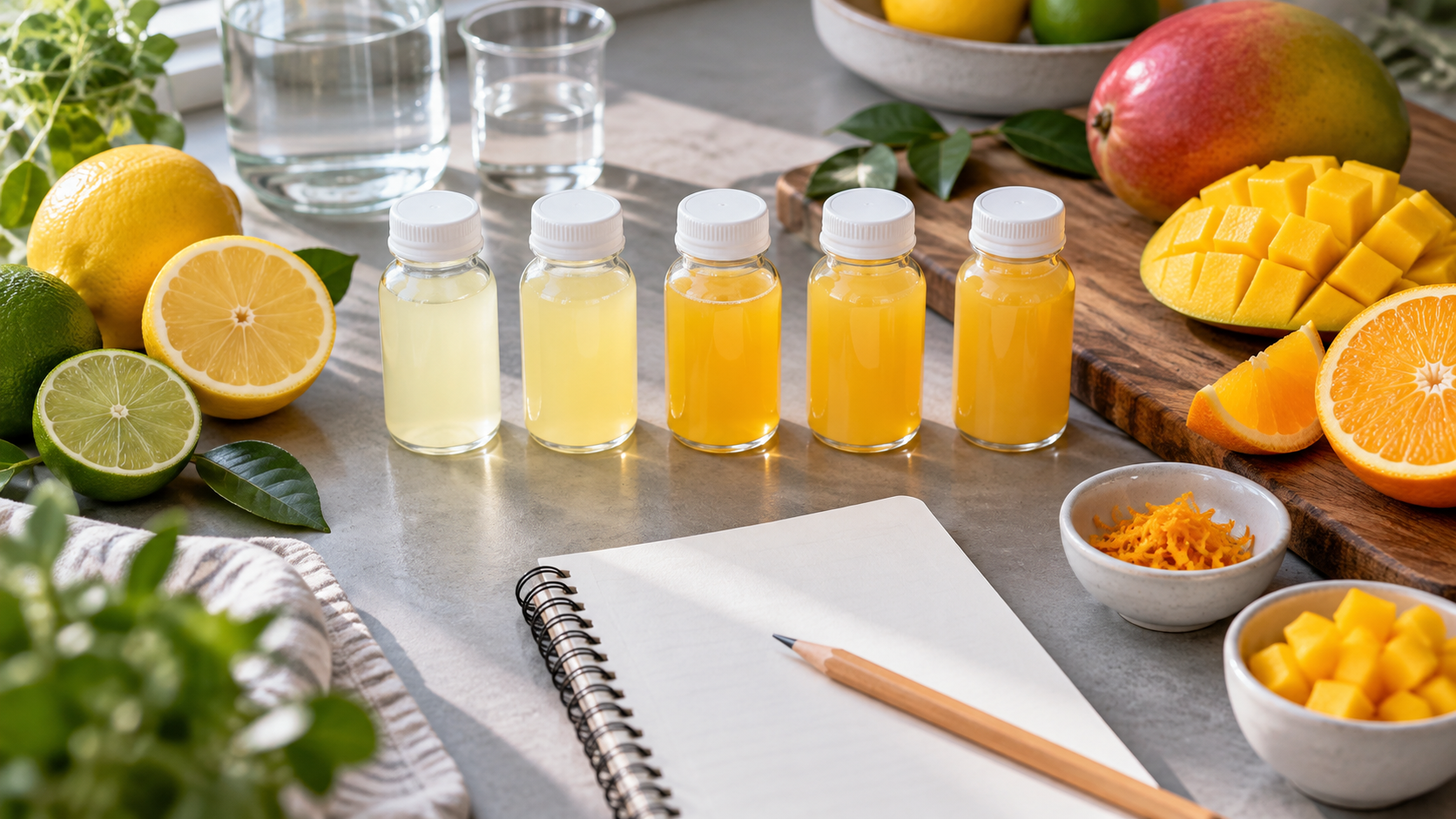
Benchtop work builds candidate formulations at small scale and tests them against the brief. The output is not a finished product but a shortlist, and the value of the stage lies in how quickly it eliminates directions that will not work rather than in how quickly it finds one that does.
Two constraints shape what is possible. Ingredient availability is the first, since a formulation that depends on an input with an uncertain supply is a commercial risk regardless of how it tastes. Process compatibility is the second: a bench sample made without heat behaves differently from the same recipe after a thermal step, so the intended process has to be known before the bench work is interpreted.
Where the concept involves changing an existing formula rather than building one from nothing, the work is narrower and faster. That route is described separately in the guide to adjusting flavour, sweetness and ingredients.
Stage 3: sample rounds and approval
Sample rounds are where most calendar time is spent, and the number of rounds is driven mainly by the quality of the feedback rather than by the difficulty of the product. Feedback that names attributes gives the next round a direction; feedback that reports a general impression gives it a guess.
| Stage | What it produces | What the brand owner decides |
|---|---|---|
| Concept and brief | A written set of requirements | Format, market, positioning, what is fixed |
| Benchtop formulation | A shortlist of candidate recipes | Which directions to continue and which to drop |
| Sample rounds | Refined samples against the brief | Attribute-level feedback each round |
| Approval | A locked specification and reference sample | Written sign-off against tolerances |
| Scale-up and pilot | Product made on production equipment | Acceptance of any difference from bench |
| First production | Commercial batch, tested and released | Quantity, packaging and shipping terms |
Approval ends the stage properly only when it is written against a specification with analytical targets and tolerances, and a reference sample is retained. Verbal approval against a bottle leaves nothing to measure later batches against, which turns every future quality discussion into a matter of memory.

Stage 4: scale-up and pilot
Scale-up reproduces the approved sample on production equipment, and it is the stage where a project most often discovers something new. Mixing behaves differently in a large tank than in a beaker, heat transfer is not identical, and a filling line introduces oxygen and mechanical handling that a bench sample never experienced.
Small differences at this point are normal rather than a failure. What matters is whether the difference is acceptable against the specification and, if it is not, whether the formulation or the process is adjusted to close the gap. Deciding that in advance, by agreeing which attributes carry tolerance and which do not, avoids a stalled project at the least convenient moment.
Stage 5: commercial production
The first commercial batch is produced against the approved specification, tested and released only when results sit within the agreed tolerances. From this point the question changes from whether the product can be made to whether it can be made the same way again, which is answered by the specification, the release procedure and the retained reference sample rather than by the development work.
Packaging usually becomes the constraint here rather than the liquid. Printed components are made to order and carry their own production schedule, so artwork approval frequently determines the earliest possible production date. Planning artwork alongside the approval stage, rather than after it, is the single change that most often shortens a first launch.
What the stages cost a brand owner
Cost in development is not only money. Each stage consumes three resources, and projects usually run into trouble because one of the three was not planned for rather than because the budget was wrong.
Calendar time is the first, and it is dominated by shipping and review rather than by bench work. A sample round includes transit in both directions and an internal tasting, so the elapsed time per round is largely outside the laboratory. Attention is the second: every round requires someone on the brand side to taste, compare against the reference and write structured feedback, which is real work that is rarely scheduled. Money is the third, and it is concentrated late, in packaging tooling and the first production run, rather than early in the formulation.
Recognising that the expensive resource early in a project is attention, not money, changes how a project is run. Committing one person to own tasting and feedback usually shortens development more than increasing the budget does.
When development is not the right route
Full development is justified when the product needs to be genuinely different, when a formulation is intended to be exclusive, or when no existing formula matches the brief. It is poor value when the commercial objective is a brand on a shelf and an existing formula would satisfy the concept.
Three situations usually point away from custom development. The first is a tight launch window, since development consumes calendar time that a ready formula does not. The second is a modest first volume, where the fixed cost of development is spread across too few units. The third is a concept that is close to something already available, where the difference a buyer would notice is smaller than the difference the project would cost.
In those cases the faster route is to start from a formula that already exists and adjust it, or to brand it as it is. The range of what can and cannot be changed on an existing product is set out in the article on what can be changed on a beverage product, and the starting point for that route is described in exploring existing private label formulas.
What slows a development project
Delays cluster in a small number of places, and none of them are technical.
- An open brief. Leaving the target market undefined means the formulation is developed without the constraints that will later apply to ingredients and claims.
- Unstructured feedback. A comment that a sample is not right, without naming sweetness, acidity, body or aftertaste, produces another exploratory round.
- Multiple approvers. Feedback arriving from several people with different priorities and no reconciliation is the most common cause of a stalled sample cycle.
- Artwork started too early. Label content depends on the final formulation, so design begun before approval is usually revised.
- Late format changes. Changing the pack after approval can require the formulation and the process to be revisited, not only the artwork.
The common thread is that each of these is a decision, not a task. Development moves at the speed of the decisions the brand owner makes.

Frequently asked questions
How many sample rounds are normal?
There is no fixed number, because it depends on how specific the brief was and how precise the feedback is. A project with a named reference product and clear constraints usually converges in fewer rounds than one still exploring what the product should be.
Can development start before the market is chosen?
It can, but it often causes rework. Permitted ingredients, permitted claims and label requirements vary by market, so a formulation developed without a destination may need changing once one is chosen. Naming even a provisional market avoids most of that.
Who owns the formula at the end?
That depends on the agreement rather than on the process, and it is worth settling in writing before development begins. The position differs between a formula developed specifically for a brand and an existing formula that has been adjusted.
What is the difference between scale-up and production?
Scale-up proves the product can be made on production equipment. Production proves it can be made repeatedly to the same specification. The second depends on documentation and control rather than on formulation work, which is why approval has to be written rather than verbal.
Working out which stage you are at
Most projects that feel stuck are being managed as though they are at a later stage than they really are. A concept still being discussed is at stage one, however many samples have been tasted, and the fastest way forward is usually to write the brief properly rather than to request another round.
ACM Beverage works with brand owners through these stages, from a written brief to an approved specification and first production. A brief that names the format, the target market, the sweetness direction and a reference product is enough to start, and it is also the input that most reliably shortens everything that follows.