

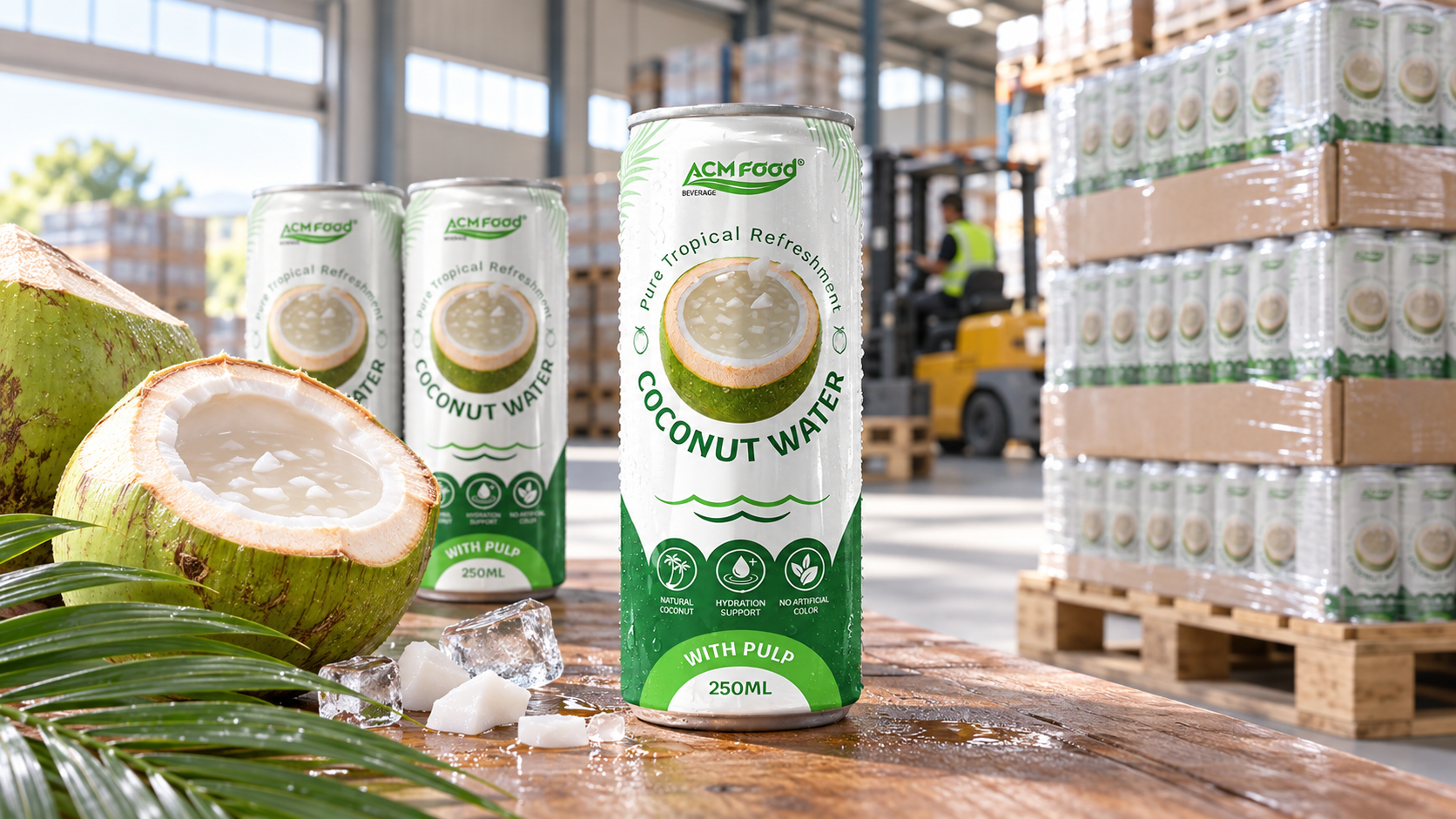
Coconut water wholesale price is the per-unit or per-carton price a distributor, retailer or importer pays when buying coconut water in trade quantities, usually quoted before local taxes and the importer’s own logistics. There is no single market price: the figure on a quotation is built from the raw coconut, the recipe, the pack format, the carton configuration, the order volume and the trade term the price is quoted under.
This guide breaks down what drives a coconut water quotation, how FOB and other Incoterms change what is included, why the same liquid can cost more or less per litre in different packs, and how to compare offers from several suppliers fairly. It does not publish prices, because any figure would depend on a specific specification and date. Instead, it shows buyers which questions to ask so a quote can be compared like for like.
What drives the wholesale price of coconut water?
The wholesale price of coconut water is driven mainly by raw material, recipe, packaging format, order volume and the trade term of the quote. Packaging and trade terms often explain more of the gap between two quotations than the liquid itself, which is why buyers should compare full specifications rather than headline prices.
The main cost drivers, roughly in the order buyers should check them:
- Raw coconuts: coconut availability and quality vary with season and region, and the share of fruit cost in the final price is higher for 100% coconut water than for flavoured drinks.
- Recipe: 100% coconut water, coconut water with pulp, flavoured and sparkling versions use different ingredients and processing steps.
- Pack format and size: the container, closure and label can cost as much attention as the liquid, especially in small packs.
- Carton configuration: the number of units per carton affects the price per carton and how many cartons fit in a container.
- Order volume and mix: larger runs of a single recipe and pack are generally more efficient than many small runs of different SKUs.
- Branding: a supplier’s own brand, a private label design, or custom formulation each carry different setup work.
- Trade term: FOB, CFR or CIF quotations include different shares of freight and insurance.
- Documentation and compliance: market-specific labels, tests and certificates can add cost for some destinations.
How does packaging change the price per litre?
Packaging changes the price per litre because container, closure and label costs are spread over less liquid in small packs. A 250ml can and a 1L bottle of the same coconut water will not cost the same per litre, even if the liquid is identical.
Format choice also affects logistics. Cans are light and stack tightly; PET bottles are lighter still but bulkier for their volume in some designs; larger bottles move more liquid per unit handled. The table below summarises general trade-offs. Shelf life figures are taken from current ACM FOOD coconut water product pages and apply to those products only.
| Pack format | Typical sizes | Effect on price per litre | Listed shelf life (ACM FOOD range) | Where it usually sells |
|---|---|---|---|---|
| Slim aluminium can | 250ml | Higher, because packaging is spread over a small volume | 24 months | Convenience, vending, single serve |
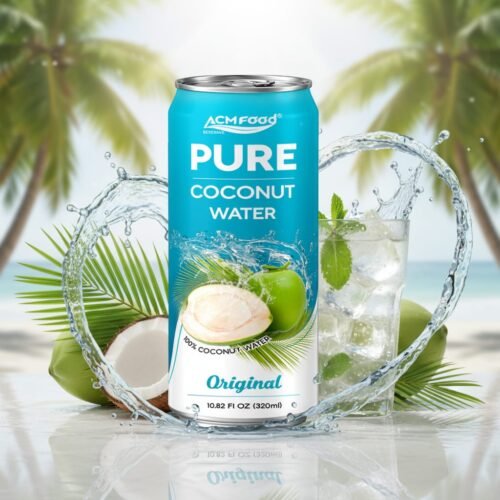
| Sleek aluminium can | 320ml | Moderate | 24 months | Retail chilled and ambient shelves |
| Standard aluminium can | 330ml, 500ml | Moderate to lower for 500ml | 24 months | Retail, foodservice, value packs |
| PET bottle | 350ml, 500ml, 1L | Lower in larger sizes | 18 months | Retail, family size, foodservice use |
For a deeper comparison of formats, see our guide to coconut water packaging options.
What is the difference between FOB, CFR and CIF coconut water prices?
FOB, CFR and CIF describe which costs are included in the price, not the value of the product. An FOB price usually looks lowest because the buyer pays sea freight and insurance separately, while CFR and CIF prices already include some or all of those costs.
- FOB (Free On Board): the seller delivers the goods loaded on the vessel at the port of loading. On our product pages, the listed port of loading is Ho Chi Minh City Port. The buyer arranges and pays freight, insurance and everything after loading.
- CFR (Cost and Freight): the seller also pays sea freight to the destination port, but risk passes to the buyer once goods are loaded.
- CIF (Cost, Insurance and Freight): as CFR, plus the seller arranges minimum insurance for the voyage.
Whatever the term, the buyer still has to budget for import duties, taxes, customs clearance, port charges, inland transport and warehousing in the destination country. When comparing a “coconut water FOB price” from one supplier with a CIF price from another, convert both to a landed cost before deciding.
How is a price per carton calculated?
A price per carton is simply the unit price multiplied by the number of units in the carton, but the carton configuration itself affects cost. Different suppliers pack different numbers of cans or bottles per carton, so two “per carton” prices can describe very different quantities of coconut water.
To compare offers correctly, ask each supplier for:
- Units per carton and the volume of each unit.
- Total litres per carton, so you can calculate price per litre.
- Cartons per pallet and per container, which shape freight cost per unit.
- Whether shrink-wrapped trays or printed outer cartons are included, and whether outer cartons carry your branding.
Once you have price per litre and price per unit side by side, differences between quotations become much easier to explain.
How do order volume and SKU mix affect the quote?
Larger, simpler orders usually earn better unit pricing because production runs, changeovers and packaging materials are used more efficiently. A buyer ordering one recipe in one pack can often negotiate differently from a buyer requesting several flavours, sizes and labels in the same shipment.
Points to raise with suppliers:
- Minimum quantities per SKU, per recipe and per label design. These are set by each supplier, so confirm them in writing; our article on beverage MOQ for private label and custom orders explains how these thresholds are usually structured.
- Whether mixed containers are possible, and how a mix of flavours or sizes changes the price.
- Price breaks at full container loads compared with smaller shipments.
- How repeat orders are priced once packaging materials and labels are already approved.
How does branding change the wholesale price?
Buying a supplier’s existing branded product is usually the simplest route, because recipe, packaging and labels already exist. Private label and custom formulation add development and setup work, which shows up either in the unit price, in one-time charges, or in higher minimum quantities.
Typical cost elements by sourcing route:
- Existing branded product: no label design work for the supplier; price reflects the standard range.
- Private label on an existing recipe: label artwork, printed cans or labels, and possibly new outer cartons. Our guide to building a private label coconut water brand covers this route.
- Custom formulation: recipe development, sampling rounds and testing before the first production run.
Which costs do buyers often forget to include?
The quotation from a supplier is only part of the cost of getting coconut water onto a shelf. Buyers who compare suppliers on unit price alone often discover extra costs later, after the margin has already been calculated.
- Import duties and taxes: rates depend on how the product is classified and on any trade agreements between origin and destination.
- Customs clearance and port charges: brokerage, terminal handling and inspection fees at the destination port.
- Inland transport and warehousing: moving containers from port to warehouse and storing stock until it sells.
- Label compliance: local-language stickers or reprinted labels if the supplier’s label does not meet destination rules.
- Testing and registration: some markets require product registration or laboratory tests before first sale.
- Shelf life risk: slow-moving stock that approaches its best-before date may need discounting, so order size should match realistic sell-through.
- Currency movements: quotations in a foreign currency change in value between order and payment.
Adding these items to the supplier price gives a landed cost per unit, the figure that really decides whether a coconut water fits a retail price point or a distributor’s margin. A slightly higher supplier price with longer shelf life, compliant labels and reliable lead times can produce a lower landed cost than the cheapest quotation.
How to compare coconut water quotations fairly
Compare quotations only after aligning specification, quantity and trade term. A lower price on a different recipe, pack or Incoterm is not a saving until the differences are priced in.
A practical comparison checklist:
- Product: 100% coconut water or blend, not from concentrate or reconstituted, with or without pulp, any added sugar or flavours.
- Pack: container type, volume, closure, label method and carton configuration.
- Shelf life: the declared shelf life and how much of it will remain on arrival.
- Trade term and port: FOB, CFR or CIF, and the named port.
- Payment terms: deposit and balance arrangements. our product pages list T/T as the payment method.
- Lead time: production and shipping schedule. Our current product pages list a lead time of 15 to 30 days, which should be confirmed per order.
- Documents: certificates, test reports and labelling support for your market.
- Validity: how long the quoted price stays valid, since raw material and freight costs move.
Requesting samples alongside the quotation lets you judge whether a price difference reflects a difference in taste or quality. For market-specific considerations, our overview of beverage products for the US market shows how destination rules can affect specification and cost.
FAQ about coconut water wholesale price
Why do two suppliers quote very different prices for coconut water?
Differences usually come from recipe, pack format, carton size, trade term or minimum quantities rather than the liquid alone. Align these points before comparing.
Is canned coconut water cost higher than PET?
It depends on size and specification. Small cans tend to cost more per litre than large PET bottles, while cans offer stronger protection from light and a longer listed shelf life in the ACM FOOD range.
Does an FOB price include shipping?
No. An FOB price covers the goods loaded at the port of loading. Sea freight, insurance, duties and inland costs are paid by the buyer.
Can I get a price without a full specification?
You can receive an indicative figure, but a firm quotation needs recipe, pack format, quantity, label route and destination market.
Conclusion
A coconut water wholesale price is the sum of choices: raw material, recipe, pack, carton configuration, volume, branding route and trade term. Packaging and Incoterms often explain more of the gap between quotations than the coconut water itself, so convert offers to price per litre and landed cost before deciding.
To receive a quotation from ACM Beverage, prepare a short brief with product style, pack size, estimated volume, label route, destination market and preferred trade term, and request samples so you can compare taste and price together.