
Most beverage launches fail on regulation and consistency, not on taste. Sugar thresholds set the recipe, packaging rules set the format, and buyers audit certification scope before they sample. These 5 factors decide whether a product can be sold at all — in the order they must be resolved.
The five factors, in the order they matter
- Destination regulation — sugar thresholds, labelling, permitted additives.
- Certification scope — GFSI recognition, and whether it covers your product.
- Batch consistency — the same drink every time, across seasons.
- Packaging and format — constrained by rules and by freight economics.
- Positioning and claims — what you can legally say in that market.
The common mistake is running this list backwards: designing artwork and a brand story, then discovering the recipe cannot be sold as formulated.
1. Destination regulation sets the recipe
Sugar is now a market-entry specification rather than a taste decision. Thailand, the Philippines, Malaysia and Brunei all tax sugar-sweetened beverages; Singapore grades every packaged drink A to D on pack and prohibits advertising the lowest grade; Vietnam has legislated a levy phasing in from 2027.
The structure matters as much as the rate. A tiered tax charges by sugar per 100 ml, so dropping below a threshold reduces the duty and gives a direct return on reformulation. A flat per-litre levy does not.
Beyond sugar: permitted additives and colours differ across markets, and a colour cleared in one region may be prohibited in another. Check this before the first bench trial, not after.
More detail in APAC sugar taxes and labelling rules.
2. Certification: scope matters more than logos
Two points that cost exporters time repeatedly:
- There is no such thing as an “FDA certified” factory. The FDA registers and inspects facilities; it does not certify them. A supplier claiming otherwise does not understand the regulation it is invoking.
- ISO 22000 alone is often not enough. Major international retailers generally require a GFSI-recognised scheme — FSSC 22000, BRCGS or IFS. ISO 22000 on its own is not GFSI-benchmarked.
Always check the scope on a certificate. It may cover only certain lines or categories, and a certificate that does not cover your product is not evidence for your product. Verify the number in the issuing body’s register rather than accepting a logo.
For US imports specifically, coconut water and juices fall under FDA Juice HACCP with a validated 5-log pathogen reduction requirement, and the importer carries Foreign Supplier Verification Program responsibility. See FDA, HACCP and ISO explained.
3. Consistency is a supply chain problem
Buyers do not reject products for being imperfect. They reject them for being different from the sample.
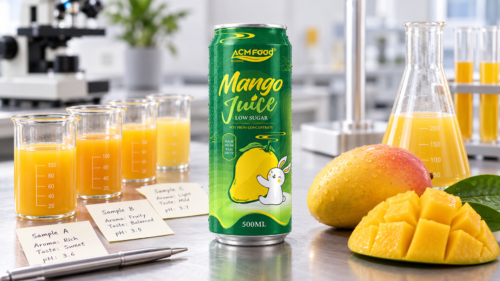
For fruit-based drinks the difficulty is agricultural: Brix, acidity and colour all shift with harvest, variety and season. Holding a specification across a year requires either blending across lots, buffering with concentrate, or accepting a tolerance band and declaring it.
Three things worth agreeing with a manufacturer in writing:
- Tolerance bands on Brix, pH and colour — not just target values.
- Retained samples per batch, so a complaint can be investigated against the actual product.
- Shelf-life-on-arrival minimums, which matter more than total shelf life for long-haul shipments.
4. Packaging is decided by rules and freight, then design
Format choice is increasingly constrained before aesthetics enter:
- Recycled content and tethered cap rules apply to product entering a market, not only product made there.
- Extended producer responsibility schemes push end-of-life cost back to the brand.
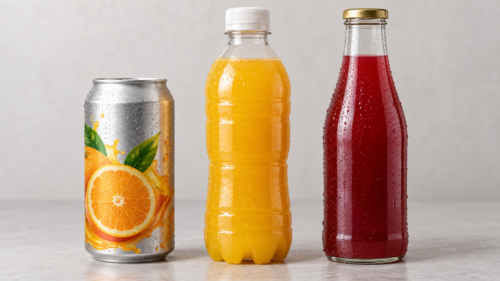
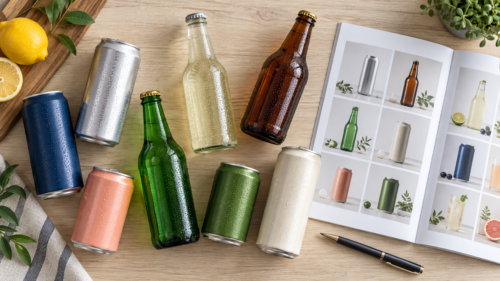
- Freight economics differ sharply: cartons are lightest and stack most efficiently, cans are heaviest but give the longest shelf life and best barrier.
- Recycling infrastructure varies. Verify it exists in the destination before making a claim on pack.
For a format-by-format comparison see alu-can vs PET vs Tetra Pak and cans, PET or glass.
5. Claims travel less well than formulas
Health and nutrition claims are regulated separately in every market, with different permitted wording and different substantiation requirements. A claim cleared in one country may be prohibited in the next.
The practical consequence: the liquid can often cross borders unchanged while the artwork cannot. Budget for market-specific label versions rather than one global design.
Claims that are easier to defend are those tied to a measurable, declared quantity — a stated vitamin C content, a declared juice percentage, a specific electrolyte figure — rather than general wellness language.
A working sequence
- Confirm sugar threshold and labelling rules for each destination.
- Confirm permitted additives and colours.
- Set the packaging format against those rules and against freight cost.
- Verify manufacturer certification scope covers your product and format.
- Develop the recipe within those constraints.
- Agree tolerance bands, retained samples and shelf-life-on-arrival.
- Write market-specific claims and artwork last.
Frequently asked questions
What is the most common reason a beverage export fails?
Regulatory mismatch discovered late — a sugar level above a destination threshold, an additive not permitted, or a packaging rule that forces a redesign. These are all knowable before development starts, which is what makes them avoidable.
Can one recipe be sold across multiple markets?
Sometimes, but rarely without adjustment. Sugar thresholds, permitted additives and local sweetness preference usually require at least some variation. A common approach is one conservative low-sugar base with market-specific sweetness and artwork.
Is FDA approval needed to export food to the US?
The FDA does not approve or certify food products or facilities. What is required is facility registration, compliance with cGMP and — for juice, including coconut water — a Juice HACCP plan with validated pathogen reduction. The US importer also carries FSVP obligations.
Which certification should I look for in a manufacturer?
A GFSI-recognised scheme such as FSSC 22000 if you intend to supply major retail. Check that the certificate’s scope covers your product category and format, and verify the number in the issuing body’s public register.
How long does it take to develop an export-ready beverage?
For an adaptation of an existing formulation, a few weeks of bench work plus stability testing. A new formulation, a new packaging format, or claim substantiation extends this considerably. Regulatory checks should run in parallel from day one, not at the end.
Should packaging or recipe be decided first?
Neither — destination regulation comes first, because it constrains both. Sugar thresholds limit the recipe and packaging rules limit the format. Fixing those two boundaries first avoids reworking everything later.
Working with ACM Beverage
ACM Beverage manufactures beverages in Vietnam under OEM and private label terms, in facilities certified to ISO 22000, FSSC 22000 and HACCP, exporting to more than 40 countries. Reduced-sugar reformulation against a named market threshold, format selection against destination packaging rules, and documentation for importer-side verification are all part of the standard development process.
See the full beverage product range or the export markets overview. To discuss a market-specific specification, contact our export team.
Regulatory information above is for orientation and changes over time. Confirm current requirements with the relevant authority or your importer before finalising a specification.