














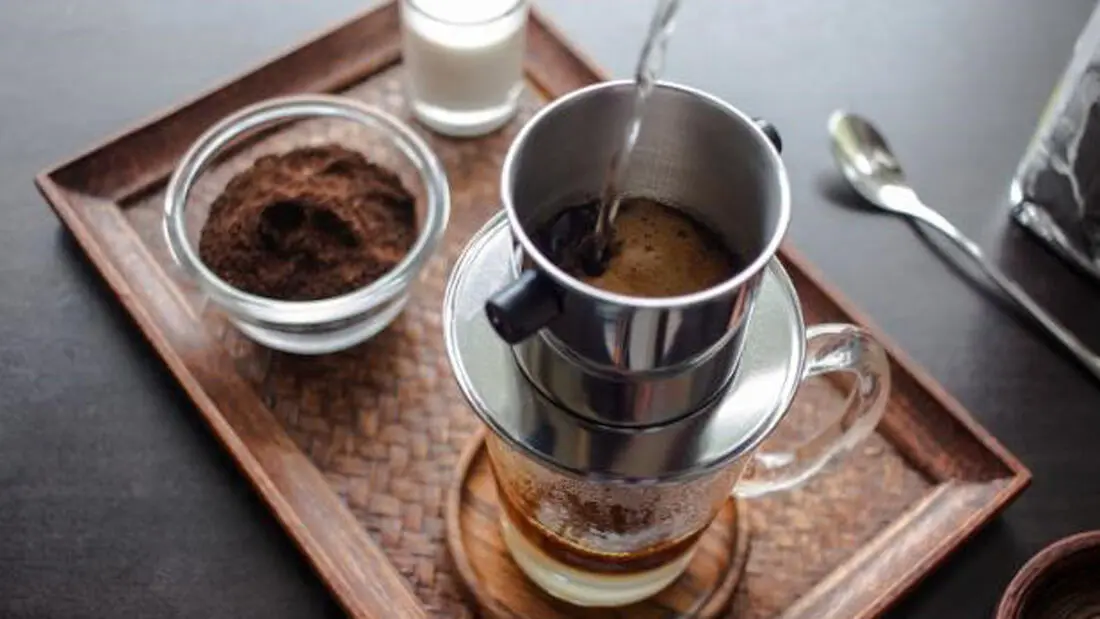
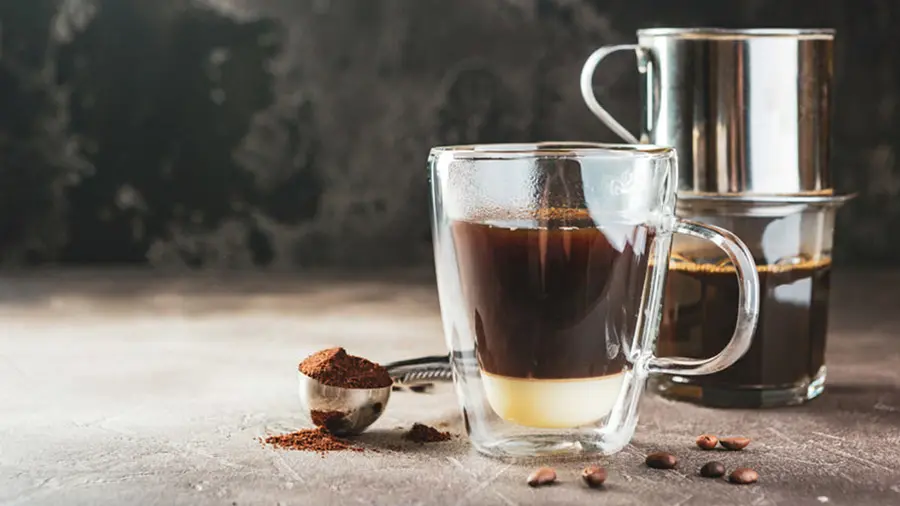
Vietnamese coffee is strong, dark-roasted coffee – mostly Robusta – brewed slowly through a small metal drip filter called a phin and often served with sweetened condensed milk. Vietnam is the world’s second-largest coffee producer after Brazil, and Robusta makes up about 95% of its crop. Classic drinks include cà phê sữa đá, cà phê đen and egg coffee.
What makes Vietnamese coffee different?
- Robusta beans: bold, bitter-chocolate flavour and roughly twice the caffeine of Arabica.
- Dark roast: traditionally roasted dark, sometimes with butter or sugar for a caramelised note.
- Phin brewing: a slow drip that produces a small, concentrated cup.
- Condensed milk: used instead of fresh milk, a habit from times when fresh dairy was scarce.
A short history
French missionaries introduced coffee to Vietnam in the mid-19th century. Plantations spread in the Central Highlands, where red basalt soils suit Robusta. After economic reforms in the late 1980s, production grew rapidly, making Vietnam the second-largest coffee exporter in the world. Arabica is grown in smaller amounts in cooler, higher areas such as Đà Lạt and Sơn La.
Arabica vs Robusta in Vietnamese coffee
| Feature | Robusta | Arabica |
|---|---|---|
| Share of Vietnam’s crop | About 95% | About 5% |
| Where grown | Central Highlands (Đắk Lắk, Gia Lai, Lâm Đồng lowlands) | Đà Lạt, Sơn La, Quảng Trị highlands |
| Taste | Strong, bitter, earthy | Softer, fruity, more acidic |
| Caffeine | About 2–2.7% | About 1.2–1.5% |
How do you brew coffee with a phin?

- Add 2–3 tablespoons of condensed milk to a glass if you want milk coffee.
- Put about 20 g of medium-coarse ground coffee in the phin and level it.
- Place the press on top and pour about 20 ml of hot water (around 92–96 °C) to let the coffee bloom for 30 seconds.
- Fill the phin with hot water (about 80–100 ml), cover and let it drip for 4–5 minutes.
- Stir, and pour over ice for iced coffee.
If it drips too fast, grind finer or press a little harder; if it stalls, grind coarser.
What are the classic Vietnamese coffee drinks?

| Drink | What it is |
|---|---|
| Cà phê đen (đá) | Black coffee, hot or over ice, often with sugar |
| Cà phê sữa đá | Iced coffee with condensed milk – the national favourite |
| Bạc xỉu | Mostly milk with a little coffee; a southern favourite |
| Cà phê trứng (egg coffee) | Hot coffee topped with egg yolk whipped with sugar and condensed milk; from Hanoi, created in 1946 |
| Cà phê cốt dừa | Coffee blended with coconut cream and ice |
| Sữa chua cà phê | Vietnamese yoghurt with a shot of coffee poured over |
| Cà phê muối (salt coffee) | Coffee with a salted cream foam; from Huế |
How much caffeine is in Vietnamese coffee?
A phin of Robusta can contain well over 100 mg of caffeine, more than a typical cup of Arabica coffee. Healthy adults should keep total caffeine under 400 mg a day (EFSA). Condensed milk adds sugar: 2 tablespoons contain around 20 g.
Ready-to-drink Vietnamese coffee
Canned and bottled coffee brings these flavours to shelves worldwide. ACM produces ready-to-drink coffee drinks for private label; browse the coffee drink range and read what is in your coffee cup.
Frequently asked questions
Why is Vietnamese coffee so strong?
Mainly because it uses Robusta beans, which contain more caffeine, and a dark roast brewed as a small concentrated cup.
Can I make Vietnamese coffee without a phin?
Yes. A moka pot or strong espresso with condensed milk gives a similar result.
What is the best coffee for Vietnamese iced coffee?
A dark-roast Robusta or Robusta-Arabica blend, medium-coarse ground.
Is weasel coffee real?
Cà phê chồn (civet coffee) exists, but much of what is sold is flavoured imitation, and caged civet production raises animal welfare concerns.






