
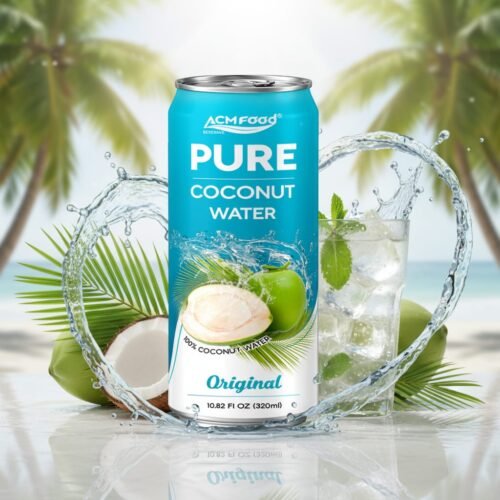
Coconut water contains about 19 kcal, 250 mg of potassium and 105 mg of sodium per 100 ml (USDA FoodData Central). That potassium level is its defining feature — higher than most sports drinks. The sodium level is the reason it does not fully replace one after heavy sweating.
Coconut water nutrition facts per 100 ml
| Nutrient | Per 100 ml | Per 330 ml serving |
|---|---|---|
| Energy | 19 kcal | ~63 kcal |
| Carbohydrate | 3.7 g | ~12.2 g |
| of which sugars | 2.6 g | ~8.6 g |
| Protein | 0.7 g | ~2.3 g |
| Fat | 0.2 g | ~0.7 g |
| Potassium | 250 mg | ~825 mg |
| Sodium | 105 mg | ~347 mg |
| Magnesium | 25 mg | ~83 mg |
| Calcium | 24 mg | ~79 mg |
| Phosphorus | 20 mg | ~66 mg |
| Vitamin C | 2.4 mg | ~7.9 mg |
Values from USDA FoodData Central for unsweetened ready-to-drink coconut water. Figures vary with coconut variety, maturity at harvest, soil salinity and distance from the coast — and sweetened products will differ substantially.
Key facts at a glance
- Harvested at 5–7 months. Younger nuts taste bitter; mature nuts hold less water and thicker flesh.
- Volume per nut: roughly 200–1000 ml, depending on cultivar and size.
- Species: Cocos nucifera, family Arecaceae.
- Not coconut milk. Coconut water is the liquid endosperm; coconut milk is pressed from the flesh and is far higher in fat.
- Low in vitamin C — 2.4 mg per 100 ml, about 3% of an adult reference intake.
What the numbers mean
The potassium is the story
At 250 mg per 100 ml, coconut water carries more potassium than most commercial sports drinks and more than an equivalent volume of orange juice. A 330 ml serving provides roughly 825 mg — a meaningful share of an adult’s daily intake. Potassium helps offset the blood-pressure effect of dietary sodium, and this is the most defensible nutritional claim for the product.
The sodium is lower than rehydration needs
This is the counterpart that marketing usually omits. Sweat loses far more sodium than potassium. A formulated oral rehydration solution or sports drink contains considerably more sodium than coconut water does, which is why coconut water suits light rehydration and everyday drinking better than recovery from heavy, prolonged sweating.
The sugar is real but modest
2.6 g per 100 ml is well below fruit juice — roughly a quarter of orange juice. It is not sugar-free, and sweetened or from-concentrate versions can carry considerably more. Check the label.
Coconut water compared
| Per 100 ml | Coconut water | Orange juice | Typical sports drink |
|---|---|---|---|
| Energy | 19 kcal | ~45 kcal | ~25 kcal |
| Sugars | 2.6 g | ~8.4 g | ~6 g |
| Potassium | 250 mg | ~200 mg | ~12–50 mg |
| Sodium | 105 mg | ~1 mg | ~45–110 mg |
What coconut water will not do
Several claims attach to coconut water that the evidence does not support:
- “Cytokinins make it anti-ageing and anti-cancer.” Kinetin and trans-zeatin have been studied in cell culture. There is no clinical evidence that drinking coconut water prevents or treats cancer, and it should never be presented that way.
- “Its enzymes aid digestion.” Enzymes in coconut water are proteins and are denatured by stomach acid before reaching the small intestine. Pasteurised product has already lost most enzyme activity anyway.
- “It is safe for everyone, including infants.” It is not an infant drink. Babies under six months need breast milk or formula only, and coconut water is not a substitute at any age in infancy without paediatric advice.
- “It replaces oral rehydration solution.” Its sodium content is too low and its osmolarity differs from WHO-ORS. In clinical dehydration, use ORS.
- “It is a good vitamin C source.” At 2.4 mg per 100 ml it is not. Citrus and guava are an order of magnitude higher.
Who should limit coconut water
- People with chronic kidney disease or on potassium-restricted diets. 825 mg per 330 ml serving is significant when potassium is being counted.
- People taking potassium-sparing diuretics or ACE inhibitors, which raise serum potassium. Discuss regular intake with a clinician.
- Infants. Not a substitute for breast milk or formula.
- Anyone rehydrating after heavy or prolonged sweating, where a higher-sodium drink is more appropriate.
Frequently asked questions
How many calories are in coconut water?
About 19 kcal per 100 ml, so roughly 63 kcal in a 330 ml serving. That is less than half of orange juice by volume. Sweetened or reconstituted products contain more.
How much potassium is in coconut water?
Around 250 mg per 100 ml, or approximately 825 mg in a 330 ml serving. This is higher than most sports drinks and slightly higher than orange juice, and it is the drink’s most notable nutritional feature.
Is coconut water better than a sports drink?
For everyday hydration and for potassium, yes. For recovery from heavy sweating, no — sweat loses more sodium than potassium, and coconut water is comparatively low in sodium. It suits light activity and daily drinking rather than endurance recovery.
Does coconut water have sugar?
Yes, about 2.6 g per 100 ml naturally, roughly a quarter of orange juice. Unsweetened not-from-concentrate product stays near that figure; sweetened versions can be considerably higher.
Is coconut water the same as coconut milk?
No. Coconut water is the clear liquid inside a young green coconut, at around 19 kcal per 100 ml. Coconut milk is pressed from the mature white flesh and is far higher in fat and calories. They are different products from different parts of the fruit.
Can you drink coconut water every day?
For most healthy adults, one or two servings a day is unremarkable. The limiting factor is potassium rather than calories — anyone with reduced kidney function or on medication affecting potassium should check intake with a clinician.
Why does coconut water taste different between brands?
Taste varies with coconut variety, maturity at harvest, soil salinity and distance from the sea, then again with processing. Not-from-concentrate product retains more of the fresh character than reconstituted concentrate.
Coconut water from ACM Beverage
ACM Beverage manufactures coconut water in Vietnam under OEM and private label terms, in facilities certified to ISO 22000, FSSC 22000 and HACCP, exporting to more than 40 countries. Packaging format is the main determinant of how well the product holds its colour and fresh character — see alu-can vs PET vs Tetra Pak.
See the fresh coconut water range (96 SKUs), or read when to drink coconut water and coconut water and heart health. To discuss a specification, contact our export team.
This article is general nutrition information, not medical advice. Consult a qualified healthcare professional about your own diet, particularly regarding potassium intake.