

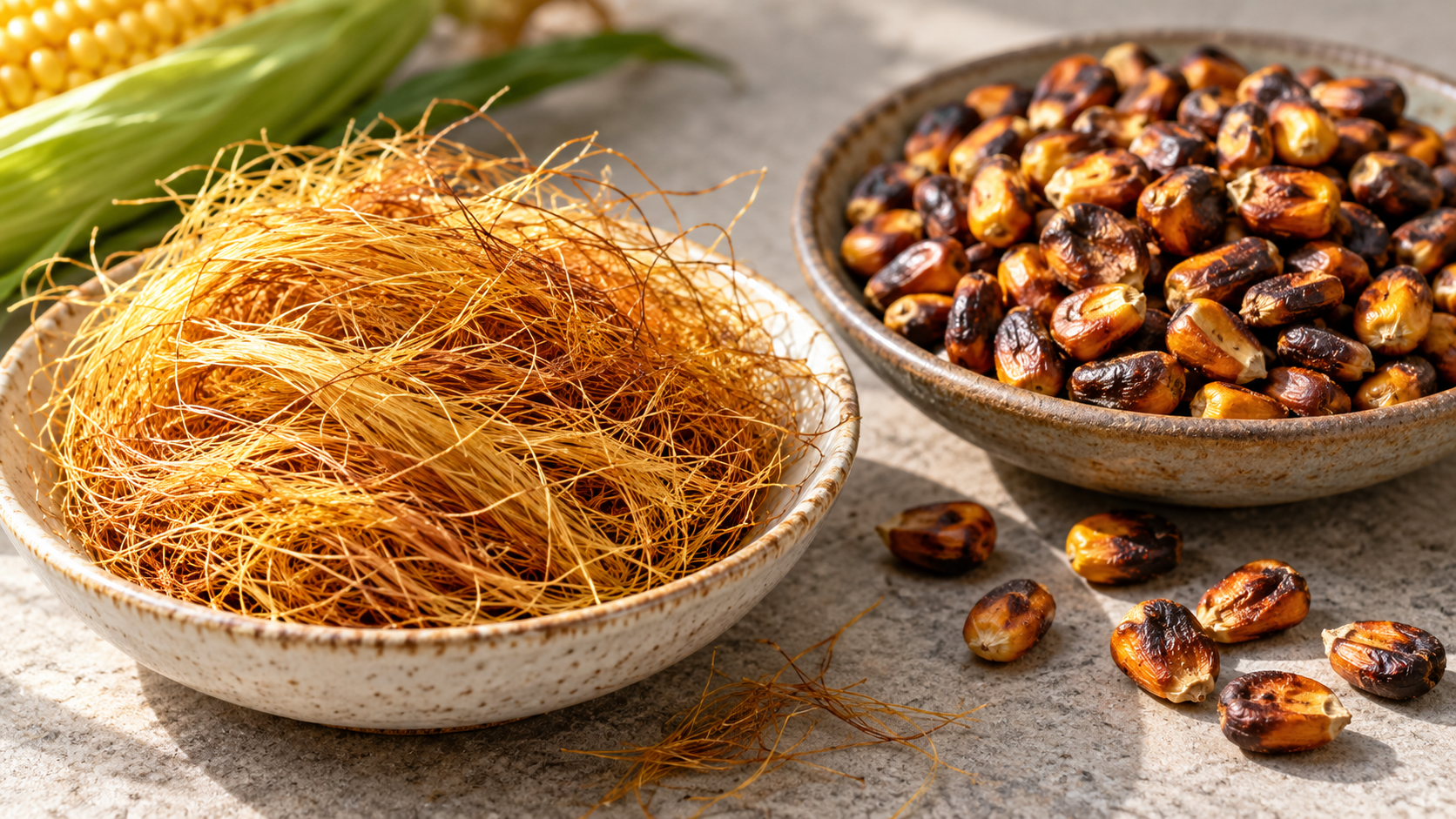
A tea corn silk drink is made by extracting dried corn silk, usually together with roasted corn kernels, in hot water, then clarifying, balancing, filling and heat treating the liquid so it stays stable on shelf. The process sounds simple, but each step affects the final taste, colour and clarity, and small changes in roasting or extraction can produce a very different drink.
This article is written for product developers and brand owners who want to understand how a tea corn silk formulation is built and what determines its shelf life and packaging. Market positioning, sales channels and SKU ideas are covered in our companion guide to Korean corn silk tea for private label, so this piece focuses only on the technical route from raw material to finished can or bottle. ACM Beverage does not currently list this product; the steps describe development on request.
How is a corn silk tea drink made, step by step?
A corn silk tea drink is typically made in six stages: raw material preparation, roasting, extraction, clarification, formulation and filling with heat treatment. Roasting and extraction set the flavour, clarification controls appearance, and the heat treatment and pack determine shelf life. Each stage should be defined in a written process before scale-up.
- Raw material preparation: corn silk is dried, sorted to remove husk and foreign matter, and checked for moisture. Kernels for roasting are cleaned and graded.
- Roasting: kernels, and sometimes the silk, are roasted to develop toasty, nutty aromas. Roast degree is the main flavour lever.
- Extraction: the roasted kernels and silk are steeped or circulated in hot water for a set time and ratio.
- Clarification: solids are removed by screening and filtration, sometimes with a cooling stage to drop out haze-forming compounds.
- Formulation: the extract is standardised, diluted and, if required, sweetened or acidified.
- Filling and heat treatment: the drink is filled into cans or bottles and processed to make it shelf stable.
Roasting: the main flavour decision
The roast defines a corn silk tea more than any other variable. Light roasting keeps a sweet, grainy taste and a pale amber colour. Medium roasting produces the familiar popcorn-like aroma of Korean bottled versions. Dark roasting brings coffee-like and slightly bitter notes with a deeper brown colour.
Consistency is the real challenge. Roast colour and aroma depend on temperature, time, batch size and kernel moisture, so a target should be set with a physical reference sample and checked for every lot. Some developers measure roast colour instrumentally; others rely on trained sensory panels. Either way, roasted material should be used within a defined window, because aroma fades as roasted kernels age.
Roasting the silk itself is optional. Toasted silk adds depth but can also introduce a burnt note if overdone, because the threads are thin and heat up quickly.
What affects extraction quality?
Extraction quality depends on the ratio of material to water, the water temperature, the contact time and how finely the material is broken. Too little extraction gives a thin, watery drink; too much pulls out bitterness and haze-forming compounds. The goal is a full roasted flavour with a clean finish.
| Variable | Effect when increased | Risk when excessive |
|---|---|---|
| Material-to-water ratio | Stronger flavour and darker colour | Heavy, bitter taste; more sediment |
| Water temperature | Faster, fuller extraction | Harsh or cooked notes; more haze |
| Contact time | More body and aroma | Bitterness and astringency |
| Particle size | Higher extraction efficiency | Fine particles that are hard to filter |
| Water quality | Soft, neutral water gives a cleaner taste | Hard or chlorinated water dulls flavour and can affect colour |
Developers often run small trials varying one factor at a time, then lock a combination that balances flavour, yield and filtration performance. The chosen settings become part of the batch record.
Balancing flavour in a tea corn silk formulation
After extraction, the base is adjusted to the final taste target. Most corn silk teas are unsweetened, so balance comes from the extract itself rather than from sugar.
- Strength: the concentrated extract is diluted to a target, often guided by soluble solids or a sensory reference, so every batch tastes the same.
- Roasted aroma: if processing reduces the roasted note, some formulas add a small amount of natural roasted corn or grain flavour, which must then be declared.
- Sweetness: lightly sweetened versions use sugar or a reduced-sugar sweetener system; the level should be tuned at chilled serving temperature.
- Acidity: corn silk tea is naturally low in acid. Adding acid changes the taste noticeably, so many products remain low-acid and rely on more intensive heat treatment instead.
- Blends: barley or brown rice can be added for a fuller grain body, but each addition needs its own extraction and stability check.

Why do corn silk tea drinks become cloudy or form sediment?
Cloudiness and sediment in corn silk tea usually come from fine particles, starch and protein from the corn, and compounds that become insoluble when the drink cools. These are not necessarily safety issues, but shoppers often read them as defects. Good filtration, controlled extraction and cold holding before filling reduce the problem.
Corn kernels contain starch, and roasting and hot water extraction can release starch fragments and proteins into the liquid. Over time, these can combine with polyphenols and settle out as a fine layer. Common control steps include:
- Coarse screening followed by finer filtration to remove particles.
- A cooling and holding step so that haze-forming material drops out before final filtration.
- Limiting extraction temperature and time to reduce what is pulled out in the first place.
- Enzyme treatment, where permitted and appropriate, to break down starch that causes haze.
A small amount of natural sediment may be acceptable if the pack carries a “shake well” note, but most bottled corn silk teas aim for a clear liquid, especially in transparent PET.
Colour stability over shelf life
Corn silk tea should keep a consistent light amber to golden-brown colour. Colour drift usually moves toward a darker, duller brown, driven by oxidation, heat exposure during storage and light in transparent packs. Minimising dissolved oxygen during filling, controlling headspace and choosing light-protective packaging all help. Colour should be measured at the start and at intervals throughout shelf-life testing, alongside taste.
Heat treatment and corn silk tea shelf life
Because most corn silk teas are low in acid, they need a heat treatment that is validated for low-acid beverages, which is more demanding than processes used for acidic juices or acidified teas. The exact method depends on the factory’s equipment and the pack format, and it must be established and validated for the specific product.
Shelf life is not a fixed figure for this category. It depends on the formula, the process, the pack and storage conditions, and it must be confirmed by testing. A sound approach includes:
- Defining the process with the production team and documenting all critical parameters.
- Running microbiological checks on finished product to confirm stability.
- Holding samples under accelerated and real-time conditions and checking taste, colour, clarity and sediment at intervals.
- Setting the best-before date on the basis of these results, with a safety margin.
Roasted aroma typically fades before other attributes change, so sensory checks often set the practical limit.
Corn silk tea packaging: technical comparison
Packaging interacts directly with processing and stability, so it should be chosen together with the heat treatment rather than at the end.
| Pack | Light and oxygen protection | Process fit | Shelf impact |
|---|---|---|---|
| Aluminium can | Very high | Suits demanding heat treatments used for low-acid drinks | Liquid not visible; strong colour protection |
| PET bottle | Moderate; depends on barrier and colour | Needs a process compatible with PET’s heat limits | Shows colour; matches Korean reference products |
| Glass bottle | High oxygen barrier; light exposure if clear | Tolerates heat well | Premium look; heavier freight |
For examples of how a tea drink is presented in a can, browse the tea drink product category. When you are ready to compare can and bottle options for your own product, the beverage builder for packaging choices collects the main variables in one place.
Technical items to include in your brief
To help the development team start from realistic assumptions, include your preferred roast level, your clarity expectation (fully clear or natural sediment accepted), sweetness position, target pack and size, the shelf life your distribution chain requires and the storage conditions in your markets. If you have reference products, send them so the team can benchmark taste, colour and sediment directly.
Quality checks that keep every batch consistent
Once a formula is approved, the work shifts from development to repeatability. Corn silk tea is sensitive to raw material and roast variation, so routine checks matter as much as the original recipe.
- Incoming raw material: moisture, appearance and odour of corn silk and kernels, checked against the agreed specification.
- Roast control: each roasted lot compared with a retained reference sample for colour and aroma.
- Extract standardisation: soluble solids or a similar measure used to dilute every batch to the same strength.
- Finished product: taste, colour, clarity and fill checks on each run, with retained samples stored for later comparison.
Keeping retained samples from each batch gives the brand and the factory a shared reference if a customer reports a taste or appearance difference months later.
Document any process deviation, even a small one such as a longer hold time or a different roast batch. When a taste complaint arrives, these records are usually the fastest way to find the cause and decide whether the issue is isolated or systemic.

Frequently asked questions about making corn silk tea drinks
Can corn silk tea be made without adding flavour?
Yes. A well-roasted and well-extracted base can carry enough flavour on its own. Natural flavour is sometimes added only to restore roasted aroma lost during heat treatment.
Why does my corn silk tea sample taste different after processing?
Heat treatment changes volatile aromas and can add cooked notes. That is why flavour targets should be judged on processed samples, not on freshly brewed liquid.
How long does bottled corn silk tea last?
There is no standard figure. Shelf life depends on the formula, heat treatment, pack and storage, and must be set through shelf-life testing on the final product.
Should the corn silk itself be roasted?
It is optional. Roasting the silk adds depth and a darker colour, but the threads are thin and burn easily, which can create bitter or smoky off-notes. Many formulas roast only the kernels and use dried, unroasted silk for a cleaner, lighter taste.
From process to product
A stable, good-tasting tea corn silk drink comes from controlled roasting, balanced extraction, careful clarification and a heat treatment and pack chosen together. Getting these right early avoids sediment, colour drift and fading aroma later. If you are planning a corn silk tea in cans or bottles, ACM Beverage can review your technical brief and explain how roast level, clarity, sweetness and packaging would be handled in development.