
Noni juice is the juice of Morinda citrifolia, authorised as a novel food in the European Union since 2003 and sold legally as a food across most major markets. The published evidence supports its composition and its safety at normal intakes — not the disease claims that circulate around it. For a brand owner, the practical question is narrower: which of those claims may lawfully appear on a label.
This article separates three things that are usually mixed together: what research actually shows, what is traditional use repeated as fact, and what you are permitted to print in the EU, the United States and the GCC.
Part 1 — What the research on Morinda citrifolia supports
Noni has a genuine regulatory and compositional file. What it does not have is a clinical file strong enough to support a health claim.
Its legal status as a food is settled
The European Commission authorised noni juice as a novel food in 2003 by Decision 2003/426/EC. It now sits in the Union list of authorised novel foods under Commission Implementing Regulation (EU) 2017/2470, with defined conditions of use:
- Permitted category: pasteurised fruit and fruit nectar based drinks.
- Maximum levels: 30 ml in one serving (which may be up to 100% noni juice), or 20 ml twice a day and not more than 40 ml per day.
- Mandatory designation: the novel food must be designated on the label as ‘Noni juice’ or ‘Juice of Morinda citrifolia’.
Noni fruit juice powder is separately authorised for food supplements at 6.6 g per day, equivalent to 30 ml of juice, designated ‘Noni juice powder’ or ‘Juice powder of Morinda citrifolia’.
Safety at normal intakes has been formally assessed
After case reports of acute hepatitis were attributed to noni, EFSA’s Panel on Dietetic Products, Nutrition and Allergies reviewed them in its 2006 opinion. The Panel found no convincing evidence for a causal relationship between the reported hepatitis and noni juice consumption, and concluded that it is unlikely that consumption of noni juice at the observed levels of intake induces adverse human liver effects.
Two points matter for how this is used in marketing. First, EFSA assessed safety only — it did not evaluate benefits, and the opinion is not an endorsement of any health effect. Second, “unlikely” is the Panel’s own hedge; the opinion still advised attention to vulnerable groups.
Composition is well characterised
Noni juice has been analysed extensively. The compounds most often reported are iridoids — principally deacetylasperulosidic acid and asperulosidic acid — together with scopoletin, rutin and polysaccharides. Antioxidant activity is consistently demonstrated in vitro. Whether that laboratory activity produces a measurable effect in people who drink it remains unresolved, which is the gap that separates noni from ingredients that have earned authorised claims.
Potassium is the one compositional figure with practical consequences: noni juice is broadly comparable to orange juice, which is why it is relevant to people on potassium-restricted diets.
Human trials exist, but they are small
Published human studies on noni are mostly small, short and heterogeneous in design, with mixed results on endpoints such as fatigue and markers of oxidative stress. No regulator has accepted this body of work as establishing a cause-and-effect relationship. That is a statement about the strength of the evidence, not a claim that noni does nothing.
Part 2 — What is traditional use, not evidence
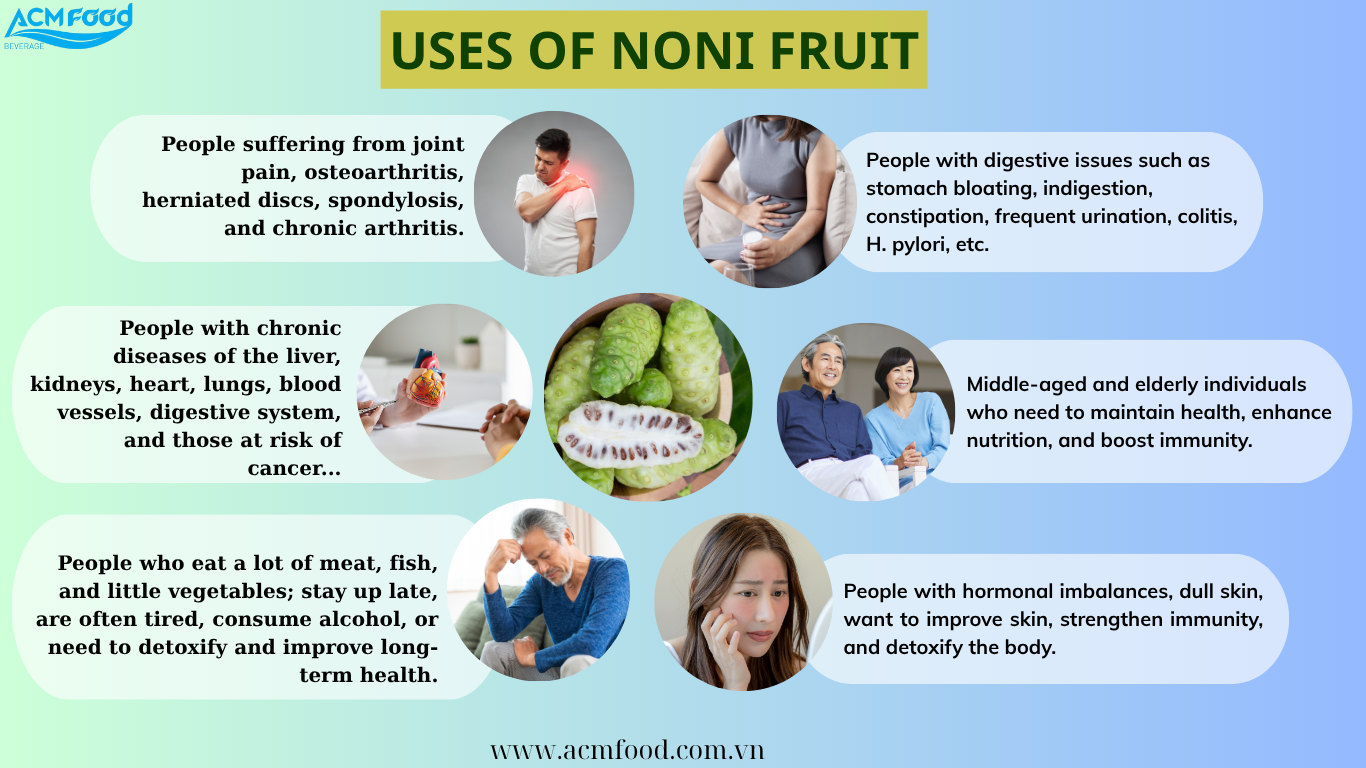
Noni has a long ethnobotanical record across Polynesia, Southeast Asia and South Asia. That record documents what people have used it for; it is not clinical evidence, and it carries no weight with a regulator. The claims below circulate widely and are not established in human trials.
| Claim in circulation | What the evidence actually shows |
|---|---|
| Antioxidant effect in the body | Demonstrated in laboratory assays; effect in people unclear |
| More energy, less fatigue | A few small trials, mixed and inconsistent results |
| Treats or controls diabetes | Not established in human trials |
| Treats or prevents cancer | Laboratory and animal data only; no human evidence |
| Treats inflammation, arthritis or joint pain | Not established in human trials |
| Fights infections, “boosts immunity” | Not established for noni itself |
| Clears skin or acne | No good evidence for drinking noni |
| Weight loss, detox, hangover relief | No controlled human evidence |
The regulatory position follows the evidence. No noni-specific health claim appears in the EU Register of nutrition and health claims, and the US FDA has authorised no health claim for noni. Any label or advertisement built on the rows above is unsupported, and in the United States has repeatedly drawn enforcement correspondence from FDA and the FTC.
Part 3 — What a brand owner may lawfully print on the label
This is the part most noni content skips. The rules below are the current framework, but they change and they interact with national implementation, so treat this as the starting point for a regulatory check, not as legal advice. Verify against the current text before artwork is signed off.
European Union
Claims are governed by Regulation (EC) No 1924/2006. The principle is restrictive: only claims that have been authorised and entered in the EU Register may be used, and the permitted health claims are listed in Commission Regulation (EU) No 432/2012. Since there is no authorised noni claim, a noni drink has three realistic routes:
- Nutrient-based claims, if the product qualifies. For beverages, a “source of” claim requires a significant amount of the nutrient, defined in Annex XIII Part A of Regulation (EU) No 1169/2011 as 7.5% of the nutrient reference value per 100 ml — against 15% per 100 g or 100 ml for non-beverages. Clear the threshold for, say, vitamin C and the authorised vitamin C function claims in 432/2012 become available to you. This is a claim about the nutrient, not about noni.
- Factual, non-claim statements. Origin, variety, process (fermented, not from concentrate), juice content and traditional-use framing carry no claim burden, provided they are accurate and not presented so as to imply a health effect.
- Mandatory wording you cannot choose. The novel food designation ‘Noni juice’ or ‘Juice of Morinda citrifolia’ must appear, and the authorised maximum use levels constrain the serving size you can put on pack.
United States
The first decision is the product category, because it changes what you may say.
- As a conventional beverage: a Nutrition Facts panel applies, and any beverage that contains juice but is not 100% juice must carry a percentage juice declaration under 21 CFR 101.30 — in the form “contains ___% juice” or “___% juice”.
- As a dietary supplement: structure/function claims are permitted under section 403(r)(6) of the FD&C Act. They require the disclaimer in 21 CFR 101.93, used verbatim — “This statement has not been evaluated by the Food and Drug Administration. This product is not intended to diagnose, treat, cure, or prevent any disease.” (“These statements” where there is more than one) — in boldface, no smaller than one-sixteenth inch, on every panel bearing a claim. You must also notify FDA of the claim text no later than 30 days after you begin marketing.
- Nutrient content claims follow 21 CFR 101.54: “good source” at 10–19% of the Daily Value per serving, “excellent source” or “high” at 20% or more.
- Disease claims remain prohibited in either category, and the disclaimer does not rescue one. A structure/function claim that names a disease is a drug claim.
GCC
The Gulf framework is both stricter in practice and more procedural, because several member states require the product and its label to be registered before sale.
- GSO 9 — Labelling of prepackaged foodstuffs: the base labelling standard, including Arabic language requirements.
- GSO 2333 — Requirements for nutrition and health claims: sets which claims are permitted and their conditions in labelling and advertising. Claims must be accurate, not misleading or deceptive, and supported by an accredited scientific reference. Claims are not permitted on foods for infants and young children except where a Codex standard or national legislation provides for them.
- GSO 2233 — Requirements for nutritional labelling: governs the nutrition panel itself.
- Registration and HALAL: expect label pre-approval through the national authority (for example the SFDA in Saudi Arabia) and HALAL certification where the buyer or market requires it. Build this time into the launch calendar — it is usually the critical path, not the formulation.
Wording that travels, and wording that does not
| Avoid | Defensible alternative |
|---|---|
| “Boosts your immune system” | “Source of vitamin C” — only if the 7.5% NRV per 100 ml threshold is met, then pair with the authorised vitamin C claim |
| “Helps control blood sugar” | Remove. No route exists for this claim on a noni drink. |
| “Detoxifies the body” | Remove. Not an authorised claim in the EU; a vague disease implication in the US. |
| “Used for centuries to treat…” | “Traditionally consumed in Polynesia and Southeast Asia” — description of use, not of effect |
| “Miracle fruit”, “superfruit” as a health implication | Describe the product: “100% noni juice, fermented, not from concentrate” |
| Therapeutic dosage language (“take 30 ml twice daily for…”) | A plain serving suggestion within the authorised maximum use level |
Who should avoid noni juice
This belongs on a brand’s FAQ or pack as a precaution, independent of any claim strategy.
- People with kidney disease or on potassium-restricted diets, because of the potassium content.
- People taking ACE inhibitors, ARBs or potassium-sparing diuretics, for the same reason.
- People with liver disease — EFSA found no causal link in the reported hepatitis cases but still advised caution.
- Pregnant and breastfeeding women — safety is not established, and traditional use includes applications that make this a clear precaution.
- Children — not recommended as a supplement.
Frequently asked questions
Are there any proven health benefits of noni juice?
No health benefit of noni has been established to a regulatory standard. Antioxidant activity is well documented in laboratory work, and human studies exist but are small and inconsistent. Neither the EU nor the US has authorised a health claim for noni.
Can I say noni juice boosts immunity on my label?
Not as a statement about noni. In the EU you could use an authorised vitamin C claim if the product contains a significant amount of vitamin C — 7.5% of the nutrient reference value per 100 ml for a beverage. In the US, an immunity-related structure/function claim on a supplement needs the 21 CFR 101.93 disclaimer and FDA notification within 30 days, and must not cross into disease territory.
How much noni juice can you drink?
In the EU, the authorised conditions of use are 30 ml in a single serving, or 20 ml twice a day up to a maximum of 40 ml per day. Commercial products commonly recommend 30–60 ml. Follow the label, and do not use noni in place of medical treatment.
Is noni juice legal to sell in the EU?
Yes. It has been authorised since 2003 and is listed in the Union list of novel foods, provided the conditions of use and the mandatory designation are respected.
What does noni juice taste like?
Bitter and pungent, with a strong aroma often compared to ripe cheese. Most commercial drinks blend it with grape, apple or berry juice, or reduce the noni content, to make it palatable.
Does noni juice cure diseases?
No. There is no good human evidence that noni treats diabetes, cancer, infections or any other disease, and presenting it that way is a regulatory violation in every market discussed here.
Noni juice from ACM Beverage
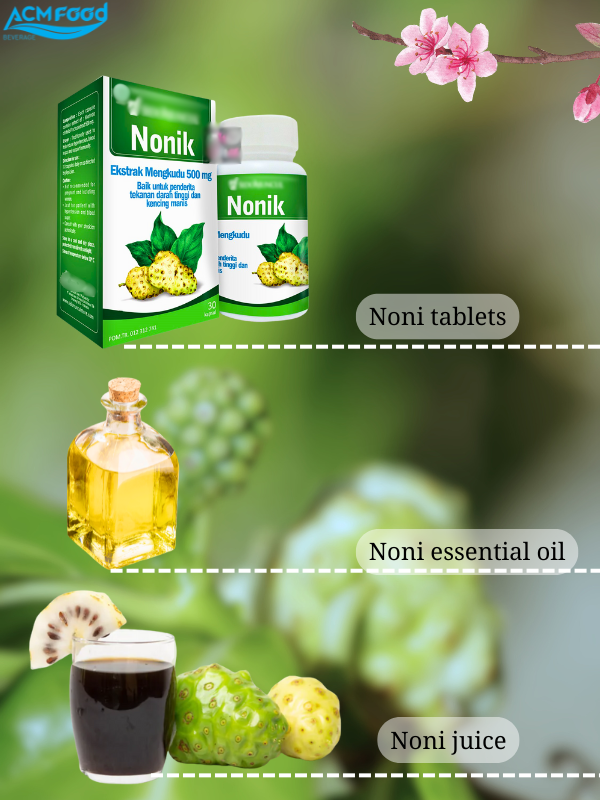
ACM Beverage produces noni juice drinks in Vietnam for OEM, ODM and private label customers, with ISO 22000, FSSC 22000 and HACCP certification and a typical lead time of 15–30 days. If you are building a noni line, the claim framework above is worth settling before artwork, not after.
- ACMFOOD Noni Fruit Juice, 500 ml PET — specifications and case configuration.
- Noni juice range — available formats and juice content tiers.
- Beverage Builder — brief a custom noni formulation or blend.
- Contact us for a specification sheet or a sample.
Sources
- Commission Decision 2003/426/EC authorising the placing on the market of noni juice as a novel food — EUR-Lex
- Commission Implementing Regulation (EU) 2017/2470, Union list of novel foods — EUR-Lex
- EFSA NDA Panel, opinion on the safety of noni juice, 2006 — EFSA Journal
- Regulation (EC) No 1924/2006 on nutrition and health claims made on foods — EUR-Lex
- Commission Regulation (EU) No 432/2012, list of permitted health claims — EUR-Lex
- Regulation (EU) No 1169/2011, Annex XIII Part A, significant amounts of vitamins and minerals — EUR-Lex
- 21 CFR 101.30, percentage juice declaration — eCFR
- 21 CFR 101.93, statements for dietary supplements — eCFR
- FDA, Structure/Function Claims — fda.gov
- GSO 9, Labelling of prepackaged foodstuffs — GSO
- UK FSA regulated products register, noni fruit juice authorisation NOVEL-97 — data.food.gov.uk
This article is general information for food and beverage professionals. It is not medical advice and not legal or regulatory advice. Consult a doctor before using noni if you have a medical condition or take medication, and have label claims reviewed by a qualified regulatory adviser for each target market before publication.