
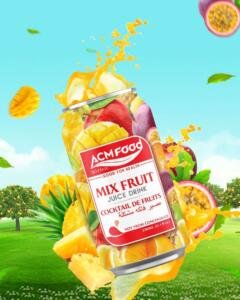
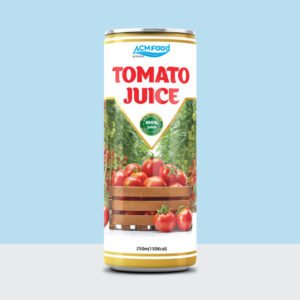
Private label fruit juice covers a wider range of products than the category name suggests. Two drinks can both be described as fruit juice on a shelf and differ completely in juice content, processing route, shelf life and the claims their labels may legally carry. For a brand entering the category, understanding those distinctions is the difference between a product that clears customs and one that does not.
Fruit juice also behaves differently from most beverage categories in one important respect: the raw material is agricultural, so availability and character shift with the harvest. That reality shapes what a manufacturer can offer you and when. This guide works through the decisions that actually determine your product, in the order a buyer usually needs them.
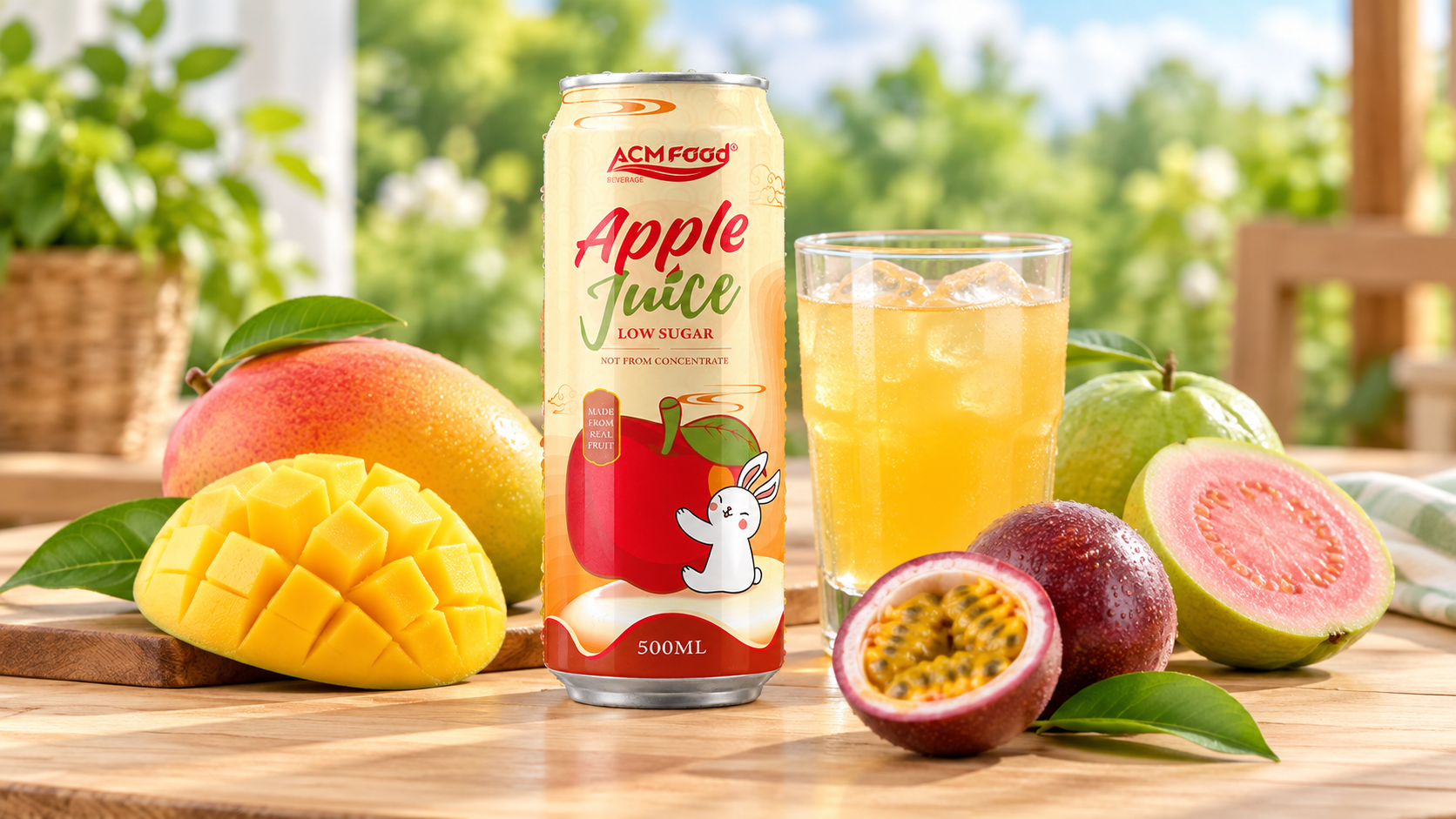
What juice content tier does your product need?
Juice content is the first decision because it governs your label wording, your cost base and your taste profile at once. Most markets distinguish between products made entirely from juice, products diluted to a defined proportion, and products where juice is one ingredient among several. The naming rules attached to each tier vary by market and are not negotiable.
Choosing a tier is a positioning decision rather than a quality judgement. A product with lower juice content is not automatically inferior, but it cannot be described as if it sat in a higher tier. Deciding this early prevents the common problem of designing a label around wording the product does not qualify for.
| Product type | Typical composition | Commercial character |
|---|---|---|
| Pure juice | Juice only, no added water | Highest raw material cost, strongest label claim |
| Nectar | Juice or puree plus water, defined minimum juice proportion | Suits thick-pulp fruits where pure juice is impractical |
| Juice drink | Lower juice proportion, additional ingredients permitted | Lower cost, wider formulation freedom, restricted wording |
Confirm the exact thresholds that apply in your destination market before finalising artwork, because the same product can fall into different tiers under different regimes.
Not from concentrate or from concentrate?
Not from concentrate means the juice is filled without first being evaporated and reconstituted. From concentrate means water was removed after pressing and added back before filling. The difference is a processing route, and it affects aroma, cost and supply logistics rather than safety.
Concentration removes volatile aromatic compounds, which is why reconstituted juice often tastes flatter in delicate fruits such as peach or apple. It also makes the raw material far cheaper to ship and store, and decouples production from the harvest calendar. Robust fruits carry concentration better than aromatic ones, which is why the choice tends to be flavour-specific rather than a blanket policy.
- Aroma retention. Not from concentrate generally preserves more of the fruit’s original character, which matters most in subtle flavours.
- Cost structure. Concentrate reduces transport and storage cost, which can be decisive at lower retail price points.
- Supply continuity. Concentrate can be stored between harvests, reducing the risk of seasonal stock gaps.
- Label value. Not from concentrate is a recognised differentiator in several markets and can support a higher price position.
How does packaging change a fruit juice product?
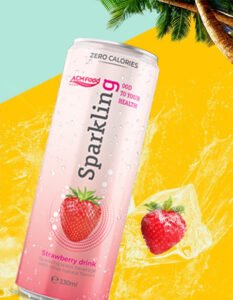
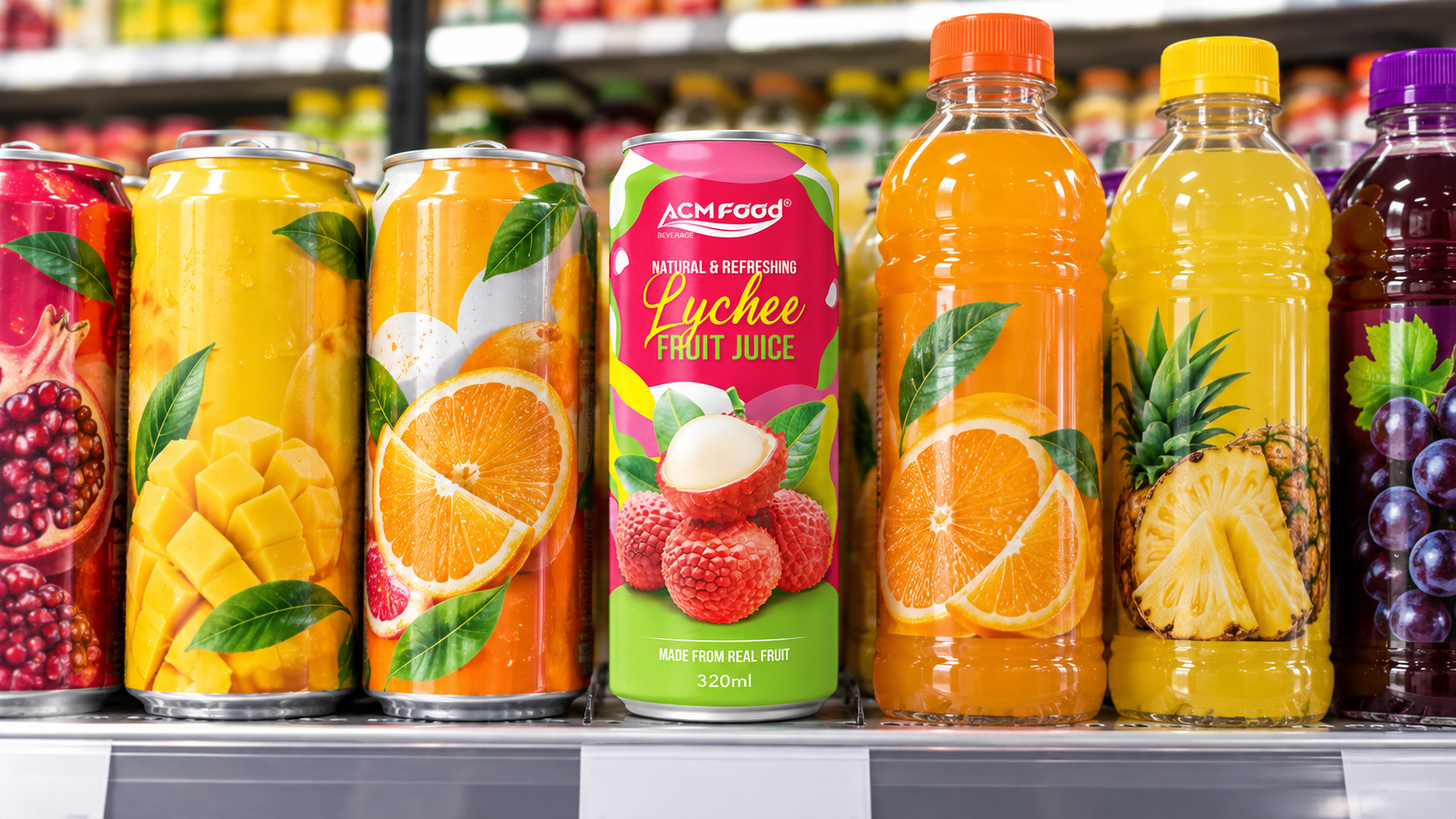
Packaging is not a neutral container for juice. It determines how much light and oxygen reach the liquid, and both degrade colour and flavour over time. Aluminium cans exclude light completely, which protects pigment-sensitive juices such as strawberry and grape. Clear bottles show the product but expose it, which is a genuine trade-off rather than a styling preference.
Format also signals price position and dictates where the product can sell. Smaller single-serve formats suit impulse and convenience channels. Larger formats suit household purchase and shelf-stable pantry positioning. Deciding the channel first usually resolves the format question faster than debating packaging in the abstract.
Existing formula or custom development for juice?
Fruit juice is a category where existing formulas cover a great deal of ground. Mainstream flavours have been produced at scale for years, and a manufacturer’s catalogue will often already contain a product close to what a new brand needs. Selecting from that catalogue removes the formulation stage and lets you taste exactly what will arrive.
Custom development earns its cost when your proposition depends on something the catalogue does not contain: an unusual flavour pairing, a specific sweetness level, a pulp or texture inclusion, or an ingredient position such as reduced sugar that is not already in production. The useful test is whether a buyer would notice the difference on shelf. If they would not, the development spend is difficult to justify.
What to confirm with a fruit juice manufacturer
A productive first conversation with a fruit juice OEM manufacturer covers a specific set of points. Working through them before discussing price prevents negotiating over a product that later proves unsuitable.
- Which juice content tier the product falls into under your destination market’s rules.
- Whether the juice is filled not from concentrate or reconstituted, and why that choice was made for the flavour.
- What the stated shelf life is, and the storage conditions under which it was established.
- Which packaging formats and sizes the formula currently runs in, as opposed to which are theoretically possible.
- How seasonal the raw material is, and what that means for replenishment mid-season.
- What the full ingredient declaration will read as on your label, including any acidity regulator or preservative.
- Who carries responsibility for label compliance in your market.
The seasonality question is the one buyers most often skip and most often regret. A flavour with a single narrow harvest window behaves differently in a supply chain from one that crops continuously, and that difference only becomes visible when you need a repeat order quickly.
How many flavours should a range launch with?
Fewer than most brands plan, and chosen for contrast rather than coverage. Every additional flavour carries its own artwork, its own minimum order quantity and its own inventory risk, while the shelf space a new brand receives rarely expands in proportion.
A focused range of two or three flavours that are visually and sensorially distinct usually outperforms a wider set that spreads volume thinly. The practical test is whether a shopper standing in front of the shelf could explain the difference between your products in one sentence. If two flavours require explanation to distinguish, one of them is diluting the other.
Contrast also helps operationally. A range built from flavours with different colour profiles faces better as a block, and a range built from fruits with different harvest patterns is less exposed to a single supply disruption.
Planning around seasonality
Fruit is agricultural, so availability and character shift across a year in ways that manufactured ingredients do not. Some fruits crop more or less continuously in tropical growing regions. Others have a narrow window and are stored or concentrated to bridge the gap.
This matters commercially at the point of reorder rather than at launch. A first production run is scheduled against known stock. A repeat order placed at the wrong point in the cycle may face longer lead times or a raw material batch with a different character, particularly for not from concentrate products where the fruit is not standardised through processing.
- Ask which fruits in your range are continuously available and which are seasonal.
- Establish whether the manufacturer bridges seasonal gaps with stored concentrate, and what that means for taste consistency.
- Agree how batch-to-batch variation will be communicated, since some variation is normal in agricultural products.
- Plan reorder points against the harvest calendar rather than against your sales forecast alone.
Brands that build this into their planning avoid the common pattern of a successful launch followed by a stock gap at exactly the moment demand has been established.
Pulp, texture and inclusions
Texture separates products that otherwise share a flavour, and it is one of the few areas where a juice can differentiate without changing what the fruit is. The options range from filtration choices that affect clarity to visible inclusions suspended in the drink.
Pulp content is the simplest lever. A juice filled with its natural pulp reads as more substantial and closer to fresh fruit, while a clarified version appears cleaner and travels better in clear packaging where sediment would be visible. Neither is inherently superior, and the right answer depends on whether your positioning emphasises freshness or refinement.
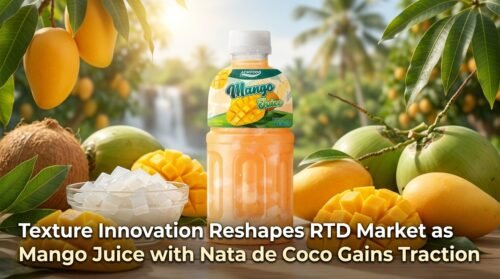
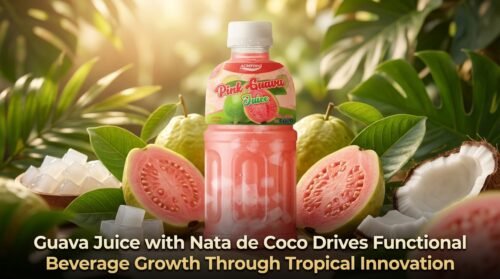
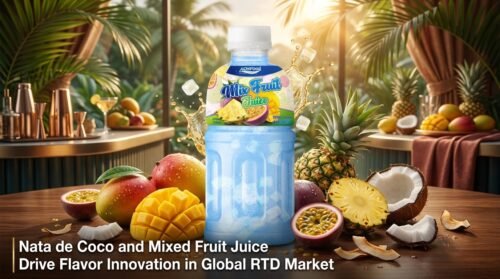
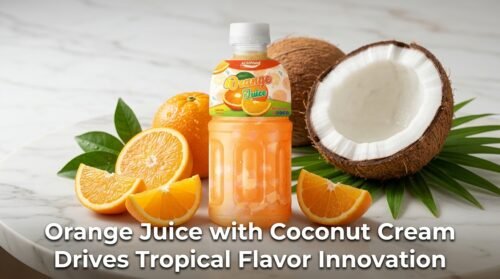
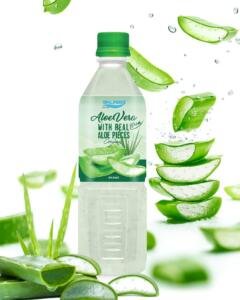
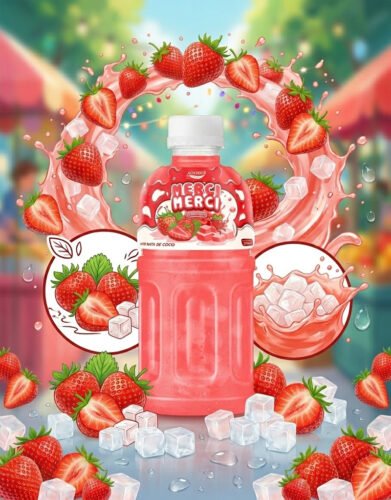
Visible inclusions such as jelly pieces or coconut gel go further, creating a product that is consumed as much as drunk. They also introduce production constraints that a smooth juice does not face. Inclusions must stay evenly distributed rather than settling, they require filling equipment able to handle solids, and they affect how the product behaves over shelf life.
- Distribution. Pieces should remain suspended rather than collecting at the base of the container.
- Filling compatibility. Not every line can handle inclusions, which narrows the packaging formats available.
- Texture over time. Inclusions can soften or firm across shelf life, so assess them late rather than at filling.
- Consumption context. A product with pieces suits leisurely drinking more than immediate refreshment.
Frequently asked questions
Can I use one label design across several flavours?
Usually yes, with flavour-specific variations in colour, imagery and the ingredient declaration. A shared design system reduces artwork cost and strengthens shelf presence when the range is faced together. The ingredient panel must still be accurate for each individual product.
Does a higher juice content always taste better?
No. Higher juice content means more fruit character, which is not the same as broader appeal. Some fruits are intensely acidic or astringent at full strength, and a diluted product can be more drinkable. Match the tier to your target consumer rather than assuming more is better.
Can sugar be reduced in an existing juice formula?
It depends on whether a reduced sugar version already exists. Switching to a product already in production is a selection decision. Reformulating an existing product to remove sugar changes taste balance and may affect stability, which places it in development territory.
How many flavours should a new range launch with?
Fewer than most brands plan. Each flavour carries its own artwork, minimum quantity and inventory risk. A focused launch with two or three flavours and clear shelf logic usually outperforms a wide range that spreads volume thinly across too many units.
Turning these decisions into a workable brief
Private label fruit juice rewards buyers who settle the regulatory and processing questions before the creative ones. Juice content tier, concentrate route, packaging format and channel together define the product far more than flavour choice does, and they determine which existing formulas are genuinely available to you.
Once those parameters are fixed, the conversation with a manufacturer becomes concrete: a shortlist of products that match, samples to evaluate against the shelf you intend to compete on, and a clear view of what would require development. If you want to see how a supplier organises a juice range across flavours and formats, our background as a Vietnamese beverage supplier sets out the categories we work across, and you can send a product brief to our team when your specification is ready. Texture inclusions are one area where the category continues to move, as the growth of mango juice with nata de coco illustrates.